A novel functional screening assay to monitor sweet taste receptor activation in vitro
Shanna Bastiaan-Net, Dianne B.P.M. Berg-Somhorst, Renata M.C. Ariëns, Marcel Paques, Jurriaan J. Mes
文献索引:10.1002/ffj.3431
全文:HTML全文
摘要
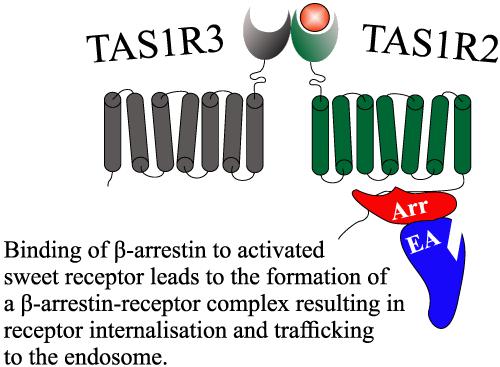
The human sweet taste receptor is a heterodimer comprised of the class C G protein-coupled receptor (GPCR) subunits TAS1R2 and TAS1R3. A wide collection of sweet tasting compounds and modulators of sweet taste interact with this receptor. Although TAS1R2/TAS1R3-mediated signaling is well-studied, the molecular basis for its desensitization remains unclear while such knowledge would signify a profound step forward in understanding the mechanism behind sweet taste perception and taste modulation. In this work, the possible involvement of β-arrestin in downstream signaling was investigated. A stable clonal Human Embryonic Kidney (HEK)-derived cell line containing the PathHunter™ GPCR technology was developed, in which β-arrestin-mediated endosomal receptor internalization can be monitored by ligand-induced enzyme complementation of β-galactosidase (β-gal). Stimulatory responses and antibody-specific receptor detection indicated that the TAS1R2/TAS1R3 receptor is endogenously expressed in this clonal cell line. Natural sugars (including fructose, glucose, sucrose, maltose, maltitol and mannitol) and artificial sweeteners (acesulfame-K and sucralose) stimulated enzyme complementation activity in a concentration dependent manner. Besides, we observed that the assay detected modification of sugar induced cell responses by sweetness enhancers. These results combined implicate that TAS1R2/TAS1R3 receptor desensitization by internalization is most likely mediated by β-arrestin-induced endocytosis. This assay approach, making use of naturally expressed TAS1R2/TAS1R3 receptors and required co-factors, further allows effective screening for and development of novel high potency non-caloric sweeteners, sweet taste modulators or optimal blends with enhanced sweet taste. Sweet taste perception is mediated by the TAS1R2/TAS1R3 receptor. Using the PathHunter™ internalization assay, we found that β-arrestin mediated endocytosis was necessary for receptor internalization and that a range of natural sugars, artificial sweeteners and sweet taste modulators induced receptor internalization in a concentration dependent manner.