Optimization and up scaling of ionic liquid tolerant and thermo-alkali stable laccase from a marine Staphylococcus arlettae S1-20 using tea waste
Prakram Singh Chauhan, Bindi Goradia, Bhavanath Jha
文献索引:10.1016/j.jtice.2018.02.032
全文:HTML全文
摘要
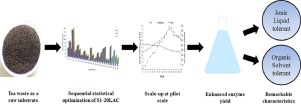
Laccase are versatile oxidoreductase enzyme having a capability of degrading variety of phenolic and non phenolic compounds. Therefore, in this work cost effective process is developed for the higher production of extracellular, thermo-alkali stable laccase (S1-20LAC) from Staphylococcus arlettae S1-20 using tea waste. To enhance the enzyme yield, multiple sequential statistical tools i.e. RSM and ANN linked GA are employed which led to 16 fold enhancement in enzyme yield. Further, a pilot scale bioprocess is developed using optimum conditions shown by GA i.e., 2.50% tea waste, 4.95 mM NaCl, 37 °C Temperature and 5.65 mM L-DOPA which led to 72 fold (879 nkatml−1) improve in the enzyme yield . The optimum temperature and pH for S1-20LAC is 85 °C and 9.0. S1-20 retained significant amount of activity even in the presence of 20% (v/v) Ionic liquids (ILs). The detailed kinetic and thermodynamic studies revealed that the overall quality of laccase is spontaneous process at high temperature. The outcome of this study shows that high production and remarkable properties of S1-20LAC offers a significant opportunity for the degradation and synthesis of wide range of compounds, which makes it an attractive green biocatalyst for the future aspects.