Computational Modeling of Antiviral Drug Diffusion from Poly(lactic-co-glycolic-acid) Fibers and Multicompartment Pharmacokinetics for Application to the Female Reproductive Tract
Michael E. Halwes, Kevin M. Tyo, Jill M. Steinbach-Rankins, Hermann B. Frieboes
文献索引:10.1021/acs.molpharmaceut.7b01089
全文:HTML全文
摘要
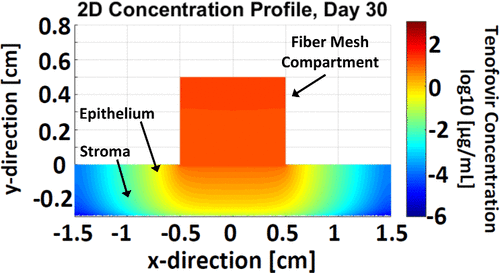
The need for more versatile technologies to deliver antiviral agents to the female reproductive tract (FRT) has spurred the development of on-demand and sustained-release platforms. Electrospun fibers (EFs), in particular, have recently been applied to FRT delivery, resulting in an alternative dosage form with the potential to provide protection and therapeutic effect against a variety of infection types. However, a multitude of fabrication parameters, as well as the resulting complexities of solvent–drug, drug–polymer, and solvent–polymer interactions, are known to significantly impact the loading and release of incorporated agents. Numerous processing parameters, in addition to their combined interactions, can hinder the iterative development of fiber formulations to achieve optimal release for particular durations, doses, and polymer–drug types. The experimental effort to design and develop EFs could benefit from mathematical analysis and computational simulation that predictively evaluate combinations of parameters to meet product design needs. Here, existing modeling efforts are leveraged to develop a simulation platform that correlates and predicts the delivery of relevant small molecule antivirals from EFs that have been recently applied to target sexually transmitted infections (STIs). A pair of mathematical models is coupled to simulate the release of two structurally similar small molecule antiretroviral reverse transcriptase inhibitors, Tenofovir (TFV) and Tenofovir disoproxil fumarate (TDF), from poly(lactic-co-glycolic acid) (PLGA) EFs, and to evaluate how changes in the system parameters affect the distribution of encapsulated agent in a three-compartment model of the vaginal epithelium. The results indicate that factors such as fiber diameter, mesh thickness, antiviral diffusivity, and fiber geometry can be simulated to create an accurate model that distinguishes the different release patterns of TFV and TDF from EFs, and that enables detailed evaluation of the associated pharmacokinetics. This simulation platform offers a basis with which to further study EF parameters and their effect on antiviral release and pharmacokinetics in the FRT.