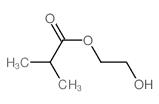
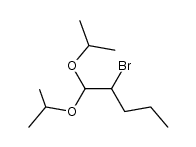
Base-catalyzed dehydrohalogenation with potassium t-butoxide in t-butyl alcohol of the acetals obtained from homologues of α-bromoacetaldehyde and ethylene glycol [2-(α- bromoalkyl)-1, 3-dioxo-lanes] or 1, 3-propanediol [2-(α-bromoalkyl)-1, 3-dioxane] provides the corresponding ketene acetal, in some cases exclusively and in others as the major product along with a smaller proportion of the α, β-unsaturated acetal. In contrast, similar ...

![2-(α-bromo-isobutyl)-[1,3]dioxolane结构式](https://image.chemsrc.com/caspic/371/33498-34-9.png)


![2-(1-bromo-1-methyl-ethyl)-[1,3]dioxolane结构式](https://image.chemsrc.com/caspic/447/33498-32-7.png)