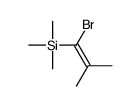
Abstract Treatment of α-chloro-or α-bromo-β, β-dimethylvinyltrimethylsilane with anhydrous tetramethylammonium fluoride (TMAF) in diglyme containing olefins led to isopropylidenecyclopropanes. A stepwise geminal dehalosilylation leading to isopropylidene carbene appears to be involved. The carbene is a species of low electrophilicity (ϱ 0.41) and reacts stereospecifically with 2-butene. The substrates α- ...




![Bicyclo[4.1.0]heptane, 7-(methylethylidene)结构式](https://image.chemsrc.com/caspic/071/53282-47-6.png)