前往化源商城

Journal of Clinical Endocrinology & Metabolism 2011-05-01

The human placenta expresses CYP17 and generates androgens de novo.

J C Escobar, S S Patel, V E Beshay, T Suzuki, B R Carr

文献索引:J. Clin. Endocrinol. Metab. 96(5) , 1385-92, (2011)

全文:HTML全文

摘要

The human placenta is believed to have insignificant CYP17 expression, rendering it dependent on the maternal and fetal compartments for the necessary androgenic precursors to yield the high levels of estrogens seen in pregnancy.The aim of the study was to analyze whether the human trophoblast is capable of expressing CYP17 and producing androgens de novo.Human trophoblasts from fresh placentas and JEG-3 cells were used for all experiments. CYP17 mRNA analysis was performed via RT-PCR, and protein detection by Western blot and immunohistochemical staining. Steroid products were quantified using RIAs.CYP17 mRNA was expressed in both cell types. CYP17 protein was detected by Western blotting and localized by immunostaining mainly to the cytoplasm of syncytiotrophoblasts. Measurement of 17α-hydroxyprogesterone, androstenedione, and their aromatized products in the media further demonstrated CYP17 expression and activity in the human trophoblast. Baseline levels of CYP17 steroid products were higher in primary cells and significantly increased in the presence of 22-hydroxycholesterol.We have demonstrated CYP17 mRNA and protein expression and activity in human trophoblasts. Considering the precursor concentration, blood flow, and mass of the placenta, we suggest that its contribution of androgens is an important source of estrogen production in pregnancy.

相关化合物

结构式 名称/CAS号 全部文献
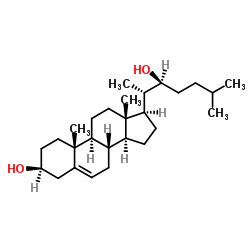
22(R)-羟基胆固醇 结构式 22(R)-羟基胆固醇
CAS:17954-98-2
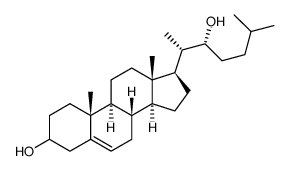
22(S)-hydroxy Cholesterol 结构式 22(S)-hydroxy Cholesterol
CAS:22348-64-7