Micelle-encapsulated thiostrepton as an effective nanomedicine for inhibiting tumor growth and for suppressing FOXM1 in human xenografts.
Ming Wang, Andrei L Gartel
文献索引:Mol. Cancer Ther. 10(12) , 2287-97, (2011)
全文:HTML全文
摘要
The thiazole antiobiotic, thiostrepton, has been found to induce cell death in cancer cells through proteasome inhibition. As a proteasome inhibitor, thiostrepton has also been shown to suppress the expression of FOXM1, the oncogenic forkhead transcription factor overexpressed in cancer cells. In this study, we explored the potential in vivo anticancer properties of thiostrepton, delivered through nanoparticle encapsulation to xenograft models of breast and liver cancer. We encapsulated thiostrepton into micelles assembled from amphiphilic lipid-PEG (polyethylene glycol) molecules, where thiostrepton is solubilized within the inner lipid compartment of the micelle. Upon assembly, hydrophobic thiostrepton molecules are solubilized into the lipid component of the micelle shell, formed through the self-assembly of amphipilic lipid-PEG molecules. Maximum accumulation of micelle-thiostrepton nanoparticles (100 nm in diameter, -16 mV in zeta potential) into tumors was found at 4 hours postadministration and was retained for at least 24 hours. Upon continuous treatment, we found that nanoparticle-encapsulated thiostrepton reduced tumor growth rates of MDA-MB-231 and HepG2 cancer xenografts. Furthermore, we show for the first time the in vivo suppression of the oncogenic FOXM1 after treatment with proteasome inhibitors. Immunoblotting and immunohistochemical staining also showed increased apoptosis in the treated tumors, as indicated by cleaved caspase-3 expression. Our data suggest that the thiazole antibiotic/proteasome inhibitor thiostrepton, when formulated into nanoparticles, may be highly suited as a nanomedicine for treating human cancer.
相关化合物
| 结构式 | 名称/CAS号 | 分子式 | 全部文献 |
|---|---|---|---|
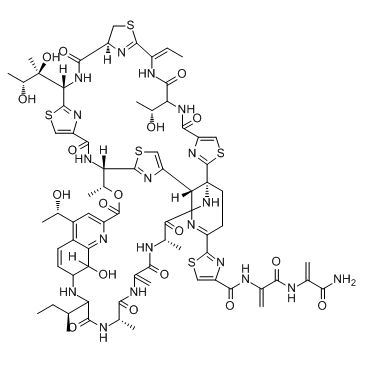 |
硫链丝菌素
CAS:1393-48-2 |
C72H85N19O18S5 |
|
ppGpp inhibits peptide elongation cycle of chloroplast trans...
2012-01-01 [Plant Mol. Biol. 78(1-2) , 185-96, (2012)] |
|
Development of a vector and host system and characterization...
2011-09-01 [Acta Biochim. Biophys. Sin. (Shanghai) 43(9) , 738-43, (2011)] |
|
Thiostrepton, proteasome inhibitors and FOXM1.
2011-12-15 [Cell Cycle 10(24) , 4341-2, (2011)] |
|
Aberrant activation of ERK/FOXM1 signaling cascade triggers ...
2011-01-01 [PLoS ONE 6 , e23790, (2011)] |
|
Thiostrepton is an inducer of oxidative and proteotoxic stre...
2012-05-01 [Biochem. Pharmacol. 83(9) , 1229-40, (2012)] |