Granisetron hydrochloride
更新时间:2023-10-02 11:36:05
| 常用名 | 盐酸格拉司琼 | CAS号 | 107007-99-8 |
|---|---|---|---|
| 价格 | $需询单/1kg | 纯度 | 99.9% |
| 备货期 | 需询单 | 库存 | 现货 |
| 产品详情(用途,包装等)
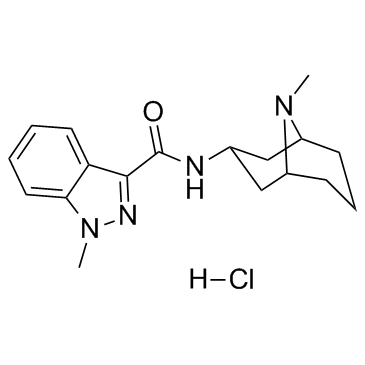
Names [ Name ]: Granisetron hydrochloride [ Synonym ]: More Synonyms Chemical & Physical Properties [ Density ]: 1.33g/cm3 [ Boiling Point ]: 532ºC at 760mmHg [ Melting Point ]: 290-292°C [ Molecular Formula ]: C18H25ClN4O [ Molecular Weight ]: 348.870 [ Flash Point ]: 275.6ºC [ Exact Mass ]: 348.171692 [ PSA ]: 50.16000 [ LogP ]: 3.44920 [ Vapour Pressure ]: 0mmHg at 25°C [ Index of Refraction ]: 1.69 MSDS
Granisetron Hydrochloride Revision number: 5 SAFETY DATA SHEET Section1. IDENTIFICATION Product name:Granisetron Hydrochloride Revision number:5 Section2. HAZARDS IDENTIFICATION GHS classification PHYSICAL HAZARDSNot classified HEALTH HAZARDS Acute toxicity (Oral)Category 4 Not classified ENVIRONMENTAL HAZARDS GHS label elements, including precautionary statements Pictograms or hazard symbols Signal wordWarning Hazard statementsHarmful if swallowed Precautionary statements: [Prevention]Do not eat, drink or smoke when using this product. Wash hands thoroughly after handling. IF SWALLOWED: Call a POISON CENTER or doctor/physician if you feel unwell. [Response] Rinse mouth. Dispose of contents/container through a waste management company authorized by [Disposal] the local government. Section3. COMPOSITION/INFORMATION ON INGREDIENTS Substance/mixture:Substance Components:Granisetron Hydrochloride Percent:>98.0%(LC)(T) CAS Number:107007-99-8 Synonyms:1-Methyl-N-[(3-endo)-9-methyl-9-azabicyclo[3.3.1]non-3-yl]-1H-indazole-3- carboxamide Hydrochloride Chemical Formula:C18H24N4O·HCl Section4. FIRST AID MEASURES Inhalation:Remove victim to fresh air and keep at rest in a position comfortable for breathing. Get medical advice/attention if you feel unwell. Skin contact:Remove/Take off immediately all contaminated clothing. Rinse skin with water/shower. If skin irritation or rash occurs: Get medical advice/attention. Granisetron Hydrochloride Section4. FIRST AID MEASURES Eye contact:Rinse cautiously with water for several minutes. Remove contact lenses, if present and easy to do. Continue rinsing. If eye irritation persists: Get medical advice/attention. Ingestion:Call a POISON CENTER or doctor/physician if you feel unwell. Rinse mouth. Protection of first-aiders:A rescuer should wear personal protective equipment, such as rubber gloves and air- tight goggles. Section5. FIRE-FIGHTING MEASURES Dry chemical, foam, water spray, carbon dioxide. Suitable extinguishing media: Precautions for firefighters: Fire-extinguishing work is done from the windward and the suitable fire-extinguishing method according to the surrounding situation is used. Uninvolved persons should evacuate to a safe place. In case of fire in the surroundings: Remove movable containers if safe to do so. Special protectiveWhen extinguishing fire, be sure to wear personal protective equipment. equipment for firefighters: Section6. ACCIDENTAL RELEASE MEASURES Personal precautions,Use personal protective equipment. Keep people away from and upwind of spill/leak. protective equipment and Entry to non-involved personnel should be controlled around the leakage area by emergency procedures: roping off, etc. Environmental precautions: Prevent product from entering drains. Methods and materials for Sweep dust to collect it into an airtight container, taking care not to disperse it. containment and cleaning Adhered or collected material should be promptly disposed of, in accordance with up: appropriate laws and regulations. Section7. HANDLING AND STORAGE Precautions for safe handling Technical measures:Handling is performed in a well ventilated place. Wear suitable protective equipment. Prevent dispersion of dust. Wash hands and face thoroughly after handling. Use a local exhaust if dust or aerosol will be generated. Advice on safe handling: Avoid contact with skin, eyes and clothing. Conditions for safe storage, including any incompatibilities Storage conditions:Keep container tightly closed. Store in a cool and dark place. Store away from incompatible materials such as oxidizing agents. Packaging material:Comply with laws. Section8. EXPOSURE CONTROLS / PERSONAL PROTECTION Engineering controls:Install a closed system or local exhaust as possible so that workers should not be exposed directly. Also install safety shower and eye bath. Personal protective equipment Respiratory protection: Dust respirator. Follow local and national regulations. Hand protection:Protective gloves. Eye protection:Safety glasses. A face-shield, if the situation requires. Skin and body protection: Protective clothing. Protective boots, if the situation requires. Section9. PHYSICAL AND CHEMICAL PROPERTIES Solid Physical state (20°C): Form:Crystal- Powder Colour:White - Almost white No data available Odour: pH: No data available Melting point/freezing point:292°C (dec.) Boiling point/range:No data available No data available Flash point: Granisetron Hydrochloride Section9. PHYSICAL AND CHEMICAL PROPERTIES Flammability or explosive limits: Lower:No data available Upper:No data available Relative density:No data available Solubility(ies): [Water]No data available No data available [Other solvents] Section10. STABILITY AND REACTIVITY Chemical stability:Stable under proper conditions. Possibility of hazardous No special reactivity has been reported. reactions: Incompatible materials: Oxidizing agents Hazardous decomposition Carbon monoxide, Carbon dioxide, Nitrogen oxides (NOx), Hydrogen chloride products: Section11. TOXICOLOGICAL INFORMATION orl-rat LD50:350 mg/kg Acute Toxicity: ivn-rat LD50:14 mg/kg Skin corrosion/irritation: No data available Serious eyeNo data available damage/irritation: Germ cell mutagenicity: mmo-sat 5 gm/L (+S9) cyt-hmn-lym 1500 mg/L Carcinogenicity: No data available IARC = NTP =No data available No data available Reproductive toxicity: RTECS Number:NK7882200 Section12. ECOLOGICAL INFORMATION Ecotoxicity: Fish:No data available Crustacea:No data available Algae:No data available Persistence / degradability: No data available No data available Bioaccumulative potential(BCF): Mobility in soil Log Pow:No data available Soil adsorption (Koc):No data available Henry's LawNo data available constant(PaM3/mol): Section13. DISPOSAL CONSIDERATIONS Recycle to process, if possible. Consult your local regional authorities. You may be able to dissolve or mix material with a combustible solvent and burn in a chemical incinerator equipped with an afterburner and scrubber system. Observe all federal, state and local regulations when disposing of the substance. Section14. TRANSPORT INFORMATION Hazards Class:Does not correspond to the classification standard of the United Nations UN-No:Not listed Granisetron Hydrochloride Section15. REGULATORY INFORMATION Safe management ordinance of dangerous chemical product (State Council announces on January 26, 2002 and revised on February 16,2011): Safe use and production, the storage of a dangerous chemical, transport, loading and unloading were prescribed. SECTION 16 - ADDITIONAL INFORMATION N/A Toxicological Information CHEMICAL IDENTIFICATION RTECS NUMBER : NK7882200 CHEMICAL NAME : 1H-Indazole-3-carboxamide, 1-methyl-N-(9-methyl-9-azabicyclo(3.3.1)non-3-yl)-, monohydrochloride, endo- CAS REGISTRY NUMBER : 107007-99-8 LAST UPDATED : 199612 DATA ITEMS CITED : 12 MOLECULAR FORMULA : C18-H24-N4-O.Cl-H MOLECULAR WEIGHT : 348.92 HEALTH HAZARD DATA ACUTE TOXICITY DATA TYPE OF TEST : LD50 - Lethal dose, 50 percent kill ROUTE OF EXPOSURE : Oral SPECIES OBSERVED : Rodent - rat DOSE/DURATION : 350 mg/kg TOXIC EFFECTS : Details of toxic effects not reported other than lethal dose value TYPE OF TEST : LD50 - Lethal dose, 50 percent kill ROUTE OF EXPOSURE : Intravenous SPECIES OBSERVED : Rodent - rat DOSE/DURATION : 14 mg/kg TOXIC EFFECTS : Behavioral - convulsions or effect on seizure threshold Behavioral - ataxia Behavioral - muscle contraction or spasticity TYPE OF TEST : LD50 - Lethal dose, 50 percent kill ROUTE OF EXPOSURE : Oral SPECIES OBSERVED : Rodent - mouse DOSE/DURATION : 350 mg/kg TOXIC EFFECTS : Details of toxic effects not reported other than lethal dose value TYPE OF TEST : LD50 - Lethal dose, 50 percent kill ROUTE OF EXPOSURE : Intravenous SPECIES OBSERVED : Rodent - mouse DOSE/DURATION : 17 mg/kg TOXIC EFFECTS : Behavioral - altered sleep time (including change in righting reflex) Behavioral - convulsions or effect on seizure threshold Lungs, Thorax, or Respiration - respiratory stimulation TYPE OF TEST : LDLo - Lowest published lethal dose ROUTE OF EXPOSURE : Intravenous SPECIES OBSERVED : Mammal - dog DOSE/DURATION : 3 mg/kg TOXIC EFFECTS : Sense Organs and Special Senses (Eye) - effect, not otherwise specified Behavioral - tremor Gastrointestinal - nausea or vomiting TYPE OF TEST : TDLo - Lowest published toxic dose ROUTE OF EXPOSURE : Oral SPECIES OBSERVED : Rodent - rat DOSE/DURATION : 4500 mg/kg/30D-I TOXIC EFFECTS : Liver - changes in liver weight Blood - changes in leukocyte (WBC) count Related to Chronic Data - death TYPE OF TEST : TDLo - Lowest published toxic dose ROUTE OF EXPOSURE : Oral SPECIES OBSERVED : Rodent - rat DOSE/DURATION : 18200 mg/kg/26W-I TOXIC EFFECTS : Liver - changes in liver weight Blood - changes in platelet count Biochemical - Enzyme inhibition, induction, or change in blood or tissue levels - phosphatases TYPE OF TEST : TDLo - Lowest published toxic dose ROUTE OF EXPOSURE : Oral SPECIES OBSERVED : Mammal - dog DOSE/DURATION : 325 mg/kg/30D-I TOXIC EFFECTS : Sense Organs and Special Senses (Eye) - lacrimation Sense Organs and Special Senses (Eye) - ptosis Behavioral - tremor TYPE OF TEST : TDLo - Lowest published toxic dose ROUTE OF EXPOSURE : Subcutaneous DOSE : 52 mg/kg SEX/DURATION : male 10 week(s) pre-mating female 2 week(s) pre-mating - 19 day(s) after conception TOXIC EFFECTS : Reproductive - Effects on Embryo or Fetus - fetotoxicity (except death, e.g., stunted fetus) MUTATION DATA TYPE OF TEST : Cytogenetic analysis TEST SYSTEM : Human Lymphocyte DOSE/DURATION : 1500 mg/L REFERENCE : KSRNAM Kiso to Rinsho. Clinical Report. (Yubunsha Co., Ltd., 1-5, Kanda Suda-Cho, Chiyoda-ku, KS Bldg., Tokyo 101, Japan) V.1- 1960- Volume(issue)/page/year: 24,6795,1990 Safety Information [ Symbol ]: GHS07 GHS07 [ Signal Word ]: Warning [ Hazard Statements ]: H302 [ Precautionary Statements ]: P301 + P312 + P330 [ Personal Protective Equipment ]: dust mask type N95 (US);Eyeshields;Faceshields;Gloves [ Hazard Codes ]: Xn: Harmful;Xi: Irritant; [ Risk Phrases ]: R22 [ Safety Phrases ]: 26-36-37 [ RIDADR ]: NONH for all modes of transport [ RTECS ]: NK7882200 [ HS Code ]: 2933990090 Synthetic RouteTotal: 1 Page 9-Methyl-9-azabicyclo[3.3.1]nonan-3-amine结构式 CAS#:76272-41-8 9-Methyl-9-azab... 1-methylindazole-3-carbonyl chloride结构式 CAS#:106649-02-9 1-methylindazol... ~% Granisetron hydrochloride Structure CAS#:107007-99-8 Granisetron hyd... Literature: US4886808 A1, ; Granisetron结构式 CAS#:109889-09-0 Granisetron ~74% Granisetron hydrochloride Structure CAS#:107007-99-8 Granisetron hyd... Literature: INKE, S.A. Patent: WO2008/151677 A1, 2008 ; Location in patent: Page/Page column 13 ; Precursor & DownStream Precursor 3 Granisetron Structure CAS#:109889-09-0 Granisetron 9-Methyl-9-azabicyclo[3.3.1]nonan-3-amine Structure CAS#:76272-41-8 9-Methyl-9-azab... 1-methylindazole-3-carbonyl chloride Structure CAS#:106649-02-9 1-methylindazol... DownStream 1 Granisetron structure CAS#:109889-09-0 Granisetron Customs [ HS Code ]: 2933990090 [ Summary ]: 2933990090. heterocyclic compounds with nitrogen hetero-atom(s) only. VAT:17.0%. Tax rebate rate:13.0%. . MFN tariff:6.5%. General tariff:20.0% Articles28More Articles Pronociceptive and Antinociceptive Effects of Buprenorphine in the Spinal Cord Dorsal Horn Cover a Dose Range of Four Orders of Magnitude. J. Neurosci. 35 , 9580-94, (2015) Due to its distinct pharmacological profile and lower incidence of adverse events compared with other opioids, buprenorphine is considered a safe option for pain and substitution therapy. However, des... Detail In vitro percutaneous absorption enhancement of granisetron by chemical penetration enhancers. Drug Dev. Ind. Pharm. 39(4) , 561-8, (2013) Granisetron (GRN), a potent antiemetic agent, is frequently used to prevent nausea and vomiting induced by cancer cytotoxic chemotherapy and radiation therapy.As part of our efforts to further modify ... Detail Comparison of the efficacy of ondansetron and granisetron to prevent postoperative nausea and vomiting after laparoscopic cholecystectomy: a systematic review and meta-analysis. Surg. Laparosc. Endosc. Percutan. Tech. 23(1) , 79-87, (2013) Our purpose was to assess the prophylactic antiemetic effects of ondansetron versus granisetron for laparoscopic cholecystectomy.We searched Medline, Cochrane Central Register of Controlled Trials, Pu... Detail Synonyms Granisetron hydrochloride 1-méthyl-N-[(3-endo)-9-méthyl-9-azabicyclo[3.3.1]non-3-yl]-1H-indazole-3-carboxamide chlorhydrate 1H-Indazole-3-carboxamide, 1-methyl-N-[(3-endo)-9-methyl-9-azabicyclo[3.3.1]non-3-yl]-, hydrochloride (1:1) 1-Methyl-N-[(3-endo)-9-methyl-9-azabicyclo[3.3.1]non-3-yl]-1H-indazole-3-carboxamide hydrochloride (1:1) 1H-indazole-3-carboxamide, 1-methyl-N-[(3-endo)-9-methyl-9-azabicyclo[3.3.1]non-3-yl]-, monohydrochloride MFCD01747034 Granisetron HCl 1-Methyl-N-[(3-endo)-9-methyl-9-azabicyclo[3.3.1]non-3-yl]-1H-indazole-3-carboxamide hydrochloride 1-Methyl-N-[(3-endo)-9-methyl-9-azabicyclo[3.3.1]non-3-yl]-1H-indazole-3-carboxamide 1-methyl-N-[(1S,5R)-9-methyl-9-azabicyclo[3.3.1]nonan-3-yl]indazole-3-carboxamide,hydrochloride 1-Methyl-N-[(3-endo)-9-methyl-9-azabicyclo[3.3.1]non-3-yl]-1H-indazol-3-carboxamidhydrochlorid 更多
|
- 上海阿拉丁生化科技股份有限公司
- 上海市 上海市 浦东新区
- 产品名:盐酸格拉司琼
- 价格: ¥31.9/10mg ¥344.9/1g ¥144.9/250mg ¥124.9/50mg
- 纯度:98.0%
- 备货期:1天
- 联系人:阿拉丁

查看所有供应商和价格请点击:
参考价格:$92/10mM*1mLinDMSO