Lauric acid cas number 143-07-7
更新时间:2026-07-06 10:32:53
| 常用名 | 月桂酸 | CAS号 | 143-07-7 |
|---|---|---|---|
| 价格 | ¥1.0/1kg | 纯度 | 99.0% |
| 备货期 | 5天 | 库存 | 现货 |
| 产品网页 | https://xcchemico.com/product/lauric-acid-cas-143-07-7/ | ||
| 产品详情(用途,包装等)
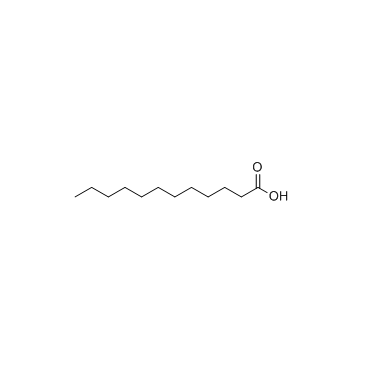
Lauric acid, also known as dodecanoic acid, is a saturated fatty acid. Its molecular formula is C12H24O2. Although named lauric acid, it only accounts for 1-3% of the content in bay oil. At present, it has been found that vegetable oils with high content of lauric acid include coconut oil 45-52%, palm kernel oil 44-52%, babassu kernel oil 43-44%, etc. Lauric acid belongs to saturated fatty acids. Product Name: Lauric Acid Alias: Dodecanoic acid English name: Lauric acid English alias: Dodecanoic acid; lauric acid free acid sigma grade; lauric acid, pure; Lauric acid 98-101 % (acidimetric) Molecular formula: C12H24O2 Structural formula: CH3 (CH2) 10COOH Molecular weight: 200.318 CAS number: 143-07-7 MDL Number: MFCD00002736 EINECS number: 205-582-1 RTECS Number: OE9800000 BRN number: 1099477 PubChem Number: 24896407 InChI:InChI=1S/C12H24O2/c1-2-3-4-5-6-7-8-9-10-11-12(13)14/h2-11H2,1H3,(H,13,14)
Physical and chemical properties Appearance: White needle shaped crystals with a slight aroma of bay oil. Density (g/mL, 50 ℃): 0.8830 Saturated vapor pressure (kPa, 121 ℃): 0.133 Melting point (℃): 44 Boiling point (℃, atmospheric pressure): 299 Flash point (℃)>110 Refractive index: 1.4183 (82 ℃), 1.4323 (45 ℃) Solubility: Insoluble in water, soluble in organic solvents such as methanol, ether, chloroform, etc., slightly soluble in acetone and petroleum ether. Room temperature refractive index (n25): 1.430450 Relative density (25 ℃, 4 ℃): 0.867550 Gas phase standard combustion heat (enthalpy) (kJ · mol-1): -7510.11 Gas phase standard heat of formation (enthalpy) (kJ · mol-1): -641.95 Liquid phase standard combustion heat (enthalpy) (kJ · mol-1): -7414.0 Liquid phase standard heat of formation (enthalpy) (kJ · mol-1): -738.1 Standard combustion heat (enthalpy) of crystalline phase (kJ · mol-1): -7377.48 Standard enthalpy of formation for crystal phase (kJ · mol-1): -774.58 Stable at room temperature and pressure: prohibited compounds: alkali, oxidant, reducing agent. It undergoes sulfation with concentrated sulfuric acid and has no chemical reaction with strong alkali. Storage method 1. Cover with a plastic bag and wrap in a burlap bag. Store in a cool, ventilated, and dry place. Keep away from heat and fire sources, moisture and sun protection. Preparation method 1. Industrial production methods can be classified into two categories: one is obtained from natural plant oils through saponification or decomposition under high temperature and high pressure; The second is to separate from synthetic fatty acids. Japan mainly produces lauric acid from coconut oil and palm kernel oil as raw materials. The natural vegetable oils used to produce dodecanoic acid include coconut oil, hawthorn kernel oil, palm kernel oil, and mountain pepper kernel oil. Other plants such as palm kernel oil, tree seed oil, camphor tree seed oil, etc. can also be used to produce dodecanoic acid in the service industry. The remaining C12 fraction from the extraction of dodecanoic acid contains a large amount of dodecenoic acid, which can be hydrogenated at atmospheric pressure without the need for catalysts and can be converted to dodecanoic acid with a conversion rate of over 86%. 2. It is obtained by separating and refining coconut oil and other vegetable oils after hydrolysis. 3. It naturally exists in the form of glycerides in coconut oil, hawthorn kernel oil, palm kernel oil, and pepper kernel oil. It can be obtained from the hydrolysis of natural oils and fats in industry. Coconut oil, water, and catalyst are added to an autoclave and hydrolyzed at 250 ℃ and a pressure of about 5MPa to form glycerol and fatty acids, which contain 45% to 80% dodecanoic acid. After distillation, dodecanoic acid is obtained. 4. Palm kernel oil production in Malaysia accounts for over half of the world's total palm oil production. Palm kernel oil is mainly composed of fatty acids ranging from C6 to C18, with lauric acid typically accounting for 46% to 51%. 5. Pepper kernel oil method. Pepper belongs to the Lauraceae family and is a deciduous tree. The stone fruit of mountain pepper is spherical in shape, initially green in color and black when ripe. The kernel oil of mountain pepper contains more than 30% lauric acid. Other plants such as palm kernel oil, sassafras seed oil, camphor seed oil, etc. can also be used to produce lauric acid. Product Usage 1. Mainly used as raw materials for the production of alkyd resins, wetting agents, detergents, insecticides, surfactants, food additives, and cosmetics. This product is often used as a lubricant and has multiple functions such as lubricant and vulcanizing agent. However, due to its corrosive effect on metals, it is generally not used for plastic products such as wires and cables. This product is widely used in the surfactant industry and can also be used in the fragrance and pharmaceutical industries. 2. Used as a surface treatment agent for preparing adhesives. It is also used in the manufacture of alkyd resins, chemical fiber oils, insecticides, synthetic fragrances, plastic stabilizers, and corrosion-resistant additives for gasoline and lubricants. Widely used in the manufacture of various types of surfactants, such as cationic types such as laurylamine, lauronitrile, trimethoprim, cinnamyl dimethylamine, and cinnamyl trimethylammonium salt; Anionic types include sodium lauroyl sulfate, lauric acid sulfate ester, and triethanolammonium lauroyl sulfate; The zwitterionic types include laurel betaine, imidazoline lauric acid, etc; Non ionic surfactants include poly (L-ol) monolauric acid ester, polyoxyethylene lauric acid ester, glycerol lauric acid ester polyoxyethylene ether, and diethanolamide lauric acid. In addition, it is also used as a food additive and in the manufacture of cosmetics. 3. Lauric acid is a raw material used in the production of soap, detergents, cosmetic surfactants, and chemical fiber oils. 更多
|
- 南通润丰石油化工有限公司
- 江苏省 南通市 崇川区
- 产品名:月桂酸
- 价格: ¥需询单/1kg ¥需询单/1ton
- 纯度:0.0%
- 备货期:1天
- 联系人:曹经理

 2143087160
复制
2143087160
复制
- 云南西力生物技术股份有限公司
- 云南省 昆明市 盘龙区
- 产品名:月桂酸
- 价格: ¥需询单/5mg
- 纯度:98.0%
- 备货期:10天
- 联系人:郑雪平
1477035482
复制
- 上海阿拉丁生化科技股份有限公司
- 上海市 上海市 浦东新区
- 产品名:月桂酸
- 价格: ¥51.9/100g ¥92.9/500g ¥148.9/100g ¥315.9/1kg
- 纯度:99.0%
- 备货期:1天
- 联系人:阿拉丁
2881459338
复制
- 盼得(上海)国际贸易有限公司
- 上海市 上海市 徐汇区
- 产品名:月桂酸
- 价格: ¥需询单/500g ¥需询单/1kg ¥需询单/25kg ¥需询单/200kg
- 纯度:0.0%
- 备货期:需询单
- 联系人:叶经理
1710932455
复制
- 苏州市森菲达化工有限公司
- 江苏省 苏州市 相城区
- 产品名:月桂酸
- 价格: ¥需询单/200kg
- 纯度:98.0%
- 备货期:需询单
- 联系人:程经理
3912721726
复制


 18796480002
复制
18796480002
复制

- 中山市迪欣化工有限公司
- 广东省 中山市 三角镇
- 产品名:十二酸(月桂酸)
- 价格: ¥60.0/25kg
- 纯度:99.0%
- 备货期:3天
- 联系人:董生
2470479589
复制
- 济南世纪通达化工有限公司
- 山东省 济南市 天桥区
- 产品名:月桂酸 十二酸
- 价格: ¥2000.0/200kg ¥10000.0/1ton
- 纯度:99.0%
- 备货期:1天
- 联系人:王经理
2856392916
复制
- 山东金悦源新材料有限公司
- 山东省 济南市 天桥区
- 产品名:月桂酸
- 价格: ¥7000.0/1ton
- 纯度:99.0%
- 备货期:1天
- 联系人:王思兵
3404852510
复制
查看所有供应商和价格请点击:
参考价格:¥500/1 g