Antimicrobial graphene materials: the interplay of complex materials characteristics and competing mechanisms
H. Enis Enis Karahan, Yilei Wang, Wei Li, Fei Liu, Liang Wang, Xiao Sui, Muhammad Adil Riaz, Yuan Chen
Index: 10.1039/C7BM00987A
Full Text: HTML
Abstract
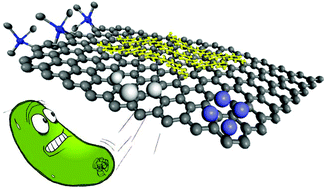
Graphene materials (GMs) exhibit attractive antimicrobial activities promising for biomedical and environmental applications. However, we still lack full control over their behaviour and performance mainly due to the complications arising from the coexistence and interplay of multiple factors. Therefore, in this minireview, we attempt to illustrate the structure–property–activity relationships of GMs’ antimicrobial activity. We first examine the chemical/physical complexity of GMs focusing on five aspects of their materials characteristics: (i) chemical composition, (ii) impurities and imperfections, (iii) lateral dimension, (iv) self-association (e.g., restacking), and (v) composite/hybrid formation. Next, we briefly summarise the current understanding of their antimicrobial mechanisms. Then, we assign the outlined materials characteristics of GMs to the proposed antimicrobial mechanisms. Lastly, we share our vision regarding the future of research and development in this fast-emerging field.