Adulteration of clove essential oil: Detection using a handheld Raman spectrometer
Paul Vargas Jentzsch, Fernando Gualpa, Luis A. Ramos, Valerian Ciobotă
Index: 10.1002/ffj.3438
Full Text: HTML
Abstract
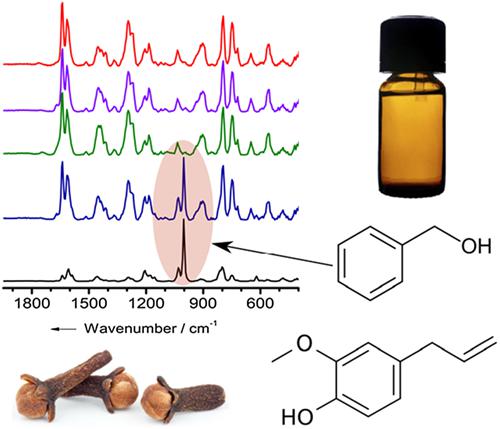
Essential oils are highly appreciated substances used as row materials in the food, cosmetics and pharmaceutical industry. Due to its biological activity and properties, the oil extracted from clove (Eugenia caryophyllus) has gained economic importance, and this is the main reason why adulterated clove essential oils have appeared in the market. The detection of adulteration is a fundamental task to ensure the quality of industrial products and, therefore, to protect the consumers from potential harmful products. In order to test the suitability of Raman spectroscopy to detect adulteration in essential oils, nineteen samples of commercial clove essential oil were measured with a handheld device and their Raman spectra analyzed. The Raman spectrum of a sample of authentic clove essential oil is dominated by bands of its main component eugenol. Principal component analysis (PCA) and independent component analysis (ICA) were applied in order to identify the adulterated samples and to assess the quality of the authentic samples. It was found that two samples were adulterated by the addition of benzyl alcohol and a third one by the addition of a vegetable oil. The adulteration by addition of benzyl alcohol is easy to detect by a quick inspection of the Raman spectrum, since this compound shows an intense band at 1003 cm-1. However, the detection of adulteration by the addition of other substances (e.g., vegetable oils) requires the application of multivariable analysis, i.e., PCA or ICA. The results show that Raman spectroscopy is an appropriate technique for quality control of clove essential oil. Nineteen samples of commercial clove essential oil were measured with a handheld device and the bands assigned. Principal Component Analysis (PCA) was applied in order to identify adulterated samples. It was found that benzyl alcohol and vegetable oils were used to adulterate clove essential oil.