Efficient Charge Separation in Plasmonic ZnS@Sn:ZnO Nanoheterostructure: Nanoscale Kirkendall Effect and Enhanced Photophysical Properties
Sumana Paul, Sirshendu Ghosh, Subodh Kumar De
Index: 10.1021/acs.langmuir.8b00442
Full Text: HTML
Abstract
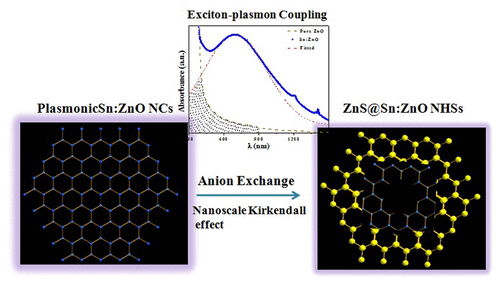
Tetravalent Sn doped ZnO nanocrystals show excellent plasmonic absorbance in the visible region. Plasmonic ZnS@Sn:ZnO core–shell heterostructures have been synthesized by the anion exchange process where the O2– is exchanged by S2– anion. An increase of sulfur concentration induces interior hollow structures arising from the different diffusion rates of O2– and S2– ions. Gradual transformation of wurtztie ZnO nanocrystals in the anion exchange process stabilizes the wurtzite crystalline phase of ZnS. Carrier concentration and various types of intrinsic defect states in both ZnO and ZnS result in ultraviolet, blue, and green emissions. The coexistence of exciton–plasmon coupling in the same nanoparticle and efficient electron–hole separation in type II heterostructure increases the photocatalytic activity and photo current gain.