Importance of Net Hydrophobicity in the Cellular Uptake of All-Hydrocarbon Stapled Peptides
Koki Sakagami, Toshihiro Masuda, Kenichi Kawano, Shiroh Futaki
Index: 10.1021/acs.molpharmaceut.7b01130
Full Text: HTML
Abstract
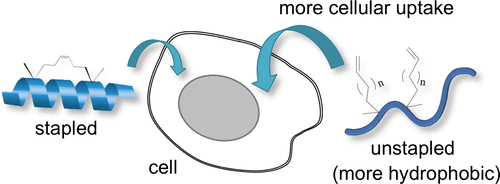
All-hydrocarbon stapled peptides make up a promising class of protein–protein interaction regulators; their potential therapeutic benefit arises because they have a high binding affinity and specificity for intracellular molecules. The cell permeation efficacy of these peptides is a critical determinant of their bioactivity. However, the factors that determine their cellular uptake remain an active area of research. In this study, we evaluated the effect of stapled (or cross-linked) formation on the cellular uptake of six known all-hydrocarbon stapled peptides. We found that the rate of cellular uptake of unstapled peptides (i.e., those bearing olefinic non-natural amino acids that are not subjected to olefin metathesis) was higher than that for the corresponding stapled peptides. Additionally, the insertion of these olefinic non-natural amino acids into peptide sequences significantly increased their rate of cellular uptake. According to the high-performance liquid chromatography retention times, the overall hydrophobicity of unstapled peptides was greater than that of stapled peptides, followed by that of the original peptides without olefinic non-natural amino acids. There was not a close correlation between helical content and the rate of cellular uptake of these peptides. Therefore, the increase in overall hydrophobicity resulting from the introduction of non-natural amino acids, rather than the structural stabilization resulting from staple formation, is the key driver promoting cellular uptake. Macropinocytosis, a form of fluid-phase endocytosis, was involved in the cellular uptake of all six peptides.