Isosteric Substitution of 4H-1,2,4-Triazole by 1H-1,2,3-Triazole in Isophthalic Derivative Enabled Hydrogel Formation for Controlled Drug Delivery
Marleen Häring, Julio Rodríguez-López, Santiago Grijalvo, Markus Tautz, Ramón Eritja, Víctor S. Martín, David Díaz Díaz
Index: 10.1021/acs.molpharmaceut.7b01049
Full Text: HTML
Abstract
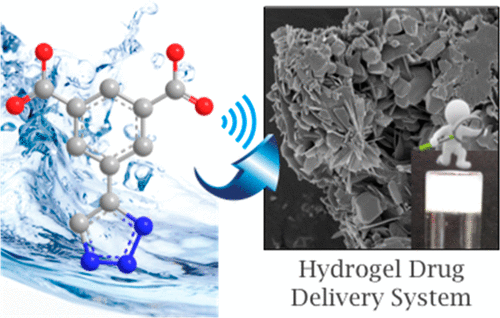
In this work, we demonstrated that the simple substitution of the 1,2,4-triazole moiety in 5-(4H-1,2,4-triazol-4-yl)isophthalic acid (5-TIA) by the 1H-1,2,3-triazol-5-yl unit enables the preparation of a hydrogelator (click-TIA). In sharp contrast to 5-TIA, its isostere click-TIA undergoes self-assembly in water upon sonication, leading to the formation of stable supramolecular viscoelastic hydrogels with a critical gelation concentration of 6 g/L. Hydrogels made of click-TIA as well as hybrid hydrogels made of the mixture click-TIA + 5-TIA (molar ratio 1:0.2) were used to compare different properties of the materials (i.e., rheological properties, thermal properties, mechanical stability, morphology). In terms of toxicity, neither click-TIA nor 5-TIA showed cytotoxic effects on cellular viability of HeLa cells up to 2.3 × 10⁻³ g/L when compared to untreated cells incubated with DMSO. Furthermore, the hydrogels were used for the encapsulation and in vitro controlled release of oxytetracycline that followed first-order kinetics. For the hydrogel made of click-TIA, a maximum drug release of ∼60% was reached after ∼8 h within a pH range between 6.5 and 10. However, the release rate was reduced to approximately half of its value at pH values between 1.2 and 5.0, whereas the use of hybrid hydrogels made of click-TIA + 5-TIA allowed to reduce the original rate at pH ≤ 6.5.