In vitro model to assess effect of antimicrobial agents on Encephalitozoon cuniculi.
B Beauvais, C Sarfati, S Challier, F Derouin
Index: Antimicrob. Agents Chemother. 38 , 2440 - 2448, (1994)
Full Text: HTML
Abstract
We have developed a new micromethod to study the effect of drugs on microsporidia, using MRC5 fibroblasts infected by 10(5) spores of Encephalitozoon cuniculi. After 3 days of incubation with various concentrations of drugs, parasitic foci were counted in stained cultures. The inhibition of microsporidial growth exceeding 90% with albendazole (0.005 microgram/ml), fumagillin (0.001 microgram/ml), 5-fluorouracil (3 micrograms/ml), and sparfloxacin (30 micrograms/ml) was observed. Chloroquine, pefloxacin, azithromycin, and rifabutin were partially effective, at high concentrations. Arprinocid, metronidazole, minocycline, doxycycline, itraconazole, and difluoromethylornithine were not evaluable, since concentrations that inhibited microsporidia were also toxic for fibroblasts. Pyrimethamine, piritrexim, sulfonamides, paromomycin, roxithromycin, atovaquone, and flucytosine were ineffective. Our results confirm that albendazole and fumagillin have marked activity against E. cuniculi and show the antimicrosporidial activity of 5-fluorouracil and sparfloxacin. These data may form the basis for treatment of Encephalitozoon hellem and Septata intestinalis infections and represent an attempt to identify drugs effective against Enterocytozoon bieneusi.
Related Compounds
| Structure | Name/CAS No. | Molecular Formula | Articles |
|---|---|---|---|
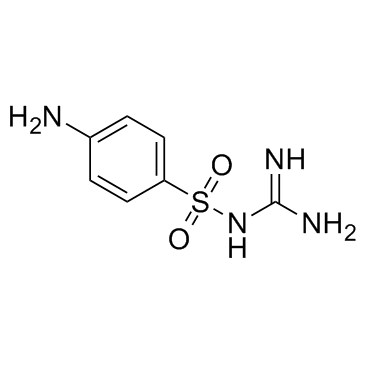 |
Sulfaguanidine
CAS:57-67-0 |
C7H10N4O2S |
|
Fast determination of 22 sulfonamides from chicken breast mu...
2014-06-06 [J. Chromatogr. A. 1345 , 17-28, (2014)] |
|
Simultaneous determination of 38 veterinary antibiotic resid...
2015-08-15 [Food Chem. 181 , 119-26, (2015)] |
|
Passive sampling: A cost-effective method for understanding ...
2015-12-01 [Environ. Int. 85 , 284-91, (2015)] |
|
DrugBank 3.0: a comprehensive resource for 'omics' research ...
2011-01-01 [Nucleic Acids Res. 39 , D1035-41., (2011)] |
|
Sensitization to oral enoxolone.
1994-02-01 [Contact Dermatitis 30(2) , 124, (1994)] |