Neurotoxicity of polychlorinated biphenyls: structure-activity relationship of individual congeners.
W Shain, B Bush, R Seegal
Index: Toxicol. Appl. Pharmacol. 111(1) , 33-42, (1991)
Full Text: HTML
Abstract
Neurotoxicity of Polychlorinated Biphenyls: Structure-Activity Relationship of Individual Congeners, Shain, W., Bush, B., Seegal, R. (1991). Toxicol. Appl. Pharmacol. 111, 33-42. Experimental and epidemiological data indicate that polychlorinated biphenyls (PCBs) may function as neurotoxicants. The mechanism(s) of action of PCBs in the brain is not well understood. One reason for our lack of understanding of PCB action in the central nervous system is that, in general, commercial mixtures of PCBs have been used for these experiments. We used a homogeneous cell line, PC12 cells, to investigate the relative potency of 43 individual PCB congeners. The neurotoxicant action of PCB congeners was measured as a decrease in cell dopamine content. We first described the potency of individual congeners; 2,2'-dichlorobiphenyl was the most potent congener (EC50 = 65 microM). The structure-activity relationships described in these experiments indicated that (i) congeners with ortho- or ortho-, para-chlorine substitutions were most potent; (ii) chlorination in a meta position decreased cell dopamine content in ortho-substituted congeners, but had little effect in ortho-, para-substituted congeners; and (iii) increasing congener chlorination did not correlate with a decrease in potency, though total chlorination of a ring appeared to reduce potency. Second, we determined that potency did not correlate with either cellular PCB content or gas chromatographic retention time. Finally, experiments with 2,2'-dichlorobiphenyl indicated that PCBs and not their metabolites were the toxicants. Thus, PCB congeners decrease cell dopamine content by interaction at specific sites that have preference for ortho- or ortho-, para-substituted congeners. The neurotoxic action of PCBs may occur by a different mechanism than PCB hepato- and immunotoxicity since these effects are most sensitive to non-ortho-substituted, dioxin-like, congeners.
Related Compounds
| Structure | Name/CAS No. | Molecular Formula | Articles |
|---|---|---|---|
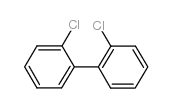 |
2,2'-DICHLOROBIPHENYL
CAS:13029-08-8 |
C12H8Cl2 |
|
Structural characterization of Pandoraea pnomenusa B-356 bip...
2013-01-01 [PLoS ONE 8(1) , e52550, (2013)] |
|
Possible molecular targets of halogenated aromatic hydrocarb...
2001-02-09 [Biochem. Biophys. Res. Commun. 280(5) , 1372-7, (2001)] |
|
Comparative toxicokinetics of 2,2'- and 4,4'-dichlorobipheny...
1990-01-01 [Arch. Environ. Contam. Toxicol. 19(4) , 565-71, (1990)] |
|
Alteration of regiospecificity in biphenyl dioxygenase by ac...
2002-07-01 [J. Bacteriol. 184(13) , 3682-8, (2002)] |
|
Revisiting the regiospecificity of Burkholderia xenovorans L...
2004-11-12 [J. Biol. Chem. 279(46) , 47489-96, (2004)] |