Propyl ether. I. Interaction with the sensory irritant receptor.
G D Nielsen, J Olsen, J C Bakbo, E Holst
Index: Acta Pharmacol. Toxicol. (Copenh.) 56(2) , 158-64, (1985)
Full Text: HTML
Abstract
The sensory irritating response of propyl ether, measured as a decrease in respiratory rate in mice, faded within one minute. The threshold was 620 p.p.m., calculated from the concentration-response curve, which had a low slope. The sensory irritating level depressing the respiratory rate to 50 per cent (RD-50 = 89,000 p.p.m.) could not be reached with saturated vapour at 20 degrees. The thermodynamic activity corresponding to the RD-50 was about 0.6, a rather high value. The low slope and high thermodynamic activity may be explained by steric hindrance of the oxygen atom and thereby decreasing the receptor-activating capacity and/or the stability of the active receptor conformation. A specific effect beyond the receptor offers another explanation.
Related Compounds
| Structure | Name/CAS No. | Molecular Formula | Articles |
|---|---|---|---|
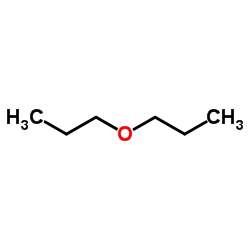 |
Propyl Ether
CAS:111-43-3 |
C6H14O |
|
Anomalously slow proton transport of a water molecule.
2011-05-19 [J. Phys. Chem. B 115(19) , 6023-31, (2011)] |
|
The unusually large Plasmodium telomerase reverse-transcript...
2005-01-01 [Nucleic Acids Res. 33 , 1111-22, (2005)] |
|
A Novel Docetaxel-Loaded Poly (ε-Caprolactone)/Pluronic F68 ...
2009-01-01 [Nanoscale Res. Lett. 4 , 1530-9, (2011)] |
|
Propyl ether. II. Pulmonary irritation and anaesthesia.
1985-02-01 [Acta Pharmacol. Toxicol. (Copenh.) 56(2) , 165-75, (1985)] |
|
Sites for uptake of inhaled vapors in beagle dogs.
1991-06-15 [Toxicol. Appl. Pharmacol. 109(2) , 263-75, (1991)] |