Raspberry ketone from submerged cultured cells of the basidiomycete Nidula niveo-tomentosa.
A Böker, M Fischer, R G Berger
Index: Biotechnol. Prog. 17(3) , 568-72, (2001)
Full Text: HTML
Abstract
The basidiomycete Nidula niveo-tomentosa produced 4-(4-hydroxyphenyl)-butan-2-one (raspberry ketone), one of the character impact components of raspberry flavor, and its corresponding alcohol. A systematic attempt was made to improve the productivity of this fungus. Variation of nutrient medium composition, precursor amount, time of supplementation, and cultivation period yielded a 50-fold increase in metabolite concentrations. Raspberry ketone and alcohol were easily isolated from the culture medium by solvent extraction. Glycosidically bound forms or accumulation of raspberry compounds in fungal cells were not detected. This microbial process offers an alternative for the production of natural raspberry flavor.
Related Compounds
| Structure | Name/CAS No. | Molecular Formula | Articles |
|---|---|---|---|
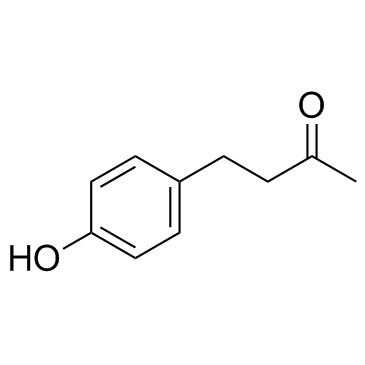 |
4-(4-Hydroxyphenyl)-2-butanone
CAS:5471-51-2 |
C10H12O2 |
|
A convenient screening method to differentiate phenolic skin...
2015-10-01 [J. Dermatol. Sci. 80 , 18-24, (2015)] |
|
Effect of essential oils, such as raspberry ketone and its d...
2010-04-01 [Bioorg. Med. Chem. Lett. 20 , 2111-4, (2010)] |
|
Molecularly imprinted polymers for cleanup and selective ext...
2015-01-01 [Anal. Bioanal. Chem 407(3) , 803-12, (2015)] |
|
Recent advances in methyl eugenol and cue-lure technologies ...
2010-01-01 [Vitam. Horm. 83 , 575-95, (2010)] |
|
Purification and biological evaluation of the metabolites pr...
2010-06-01 [Res. Microbiol. 161(5) , 335-45, (2010)] |