35Cl NOR and 19F NMR relaxation studies of CClF2 group dynamics in N(CH3)4H(ClF2CCOO)2.
M Zdanowska-Fraczek, W Medycki
Index: Solid State Nucl. Magn. Reson. 6(2) , 141-6, (1996)
Full Text: HTML
Abstract
The reorientation of CClF2 groups in N(CH3)4H(ClF2CCOO)2 has been studied using pulsed NQR and NMR techniques. The temperature dependence of both chlorine (35Cl) NQR and fluorine (19F) NMR spin-lattice relaxation has been measured T1Q of chlorine is attributed to the sum of two contributions: the reorientation of CClF2 groups and the modulation of the electric field gradient (EFG) produced by the motion of the N(CH3)4+ cations. The activation energies were determined for both kinds of motion. The fluorine relaxation is dominated by an intramolecular 19F-1H dipolar interaction. In analysis of cross-relaxation effects the spectral density functions have been evaluated using the motional parameters obtained from NQR data.
Related Compounds
| Structure | Name/CAS No. | Molecular Formula | Articles |
|---|---|---|---|
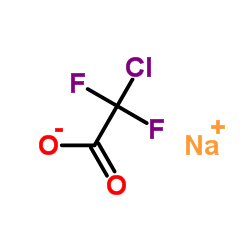 |
Sodium chlorodifluoroacetate
CAS:1895-39-2 |
C2ClF2NaO2 |
|
Synthesis and decarboxylative Wittig reaction of difluoromet...
2013-09-04 [Chem. Commun. (Camb.) 49(68) , 7513-5, (2013)] |
|
Chlorodifluoroacetic acid fate and toxicity to the macrophyt...
2001-12-01 [Environ. Toxicol. Chem. 20(12) , 2758-67, (2001)] |
|
Metabolism of the hydrochlorofluorocarbon 1,2-dichloro-1,1-d...
1991-01-01 [Chem. Res. Toxicol. 4(2) , 180-6, (1991)] |
|
Changes in tropospheric composition and air quality due to s...
2003-01-01 [Photochem. Photobiol. Sci. 2(1) , 62-7, (2003)] |
|
Low energy (0-10 eV) electron driven reactions in the haloge...
2011-09-28 [J. Chem. Phys. 135(12) , 124307, (2011)] |