Recent advances in plant hepatoprotectives: a chemical and biological profile of some important leads.
Arvind S Negi, J K Kumar, Suaib Luqman, Karuna Shanker, M M Gupta, S P S Khanuja
Index: Med. Res. Rev. 28(5) , 746-72, (2008)
Full Text: HTML
Abstract
Medicinal plants have been traditionally used for treating liver diseases since centuries. Several leads from plant sources have been found as potential hepatoprotective agents with diverse chemical structures. Although, a big list of hepatoprotective phytomolecules was reported in the scientific literature, only a few were potent against various types of liver damages. Of which, silymarin, andrographolide, neoandrographolide, curcumin, picroside, kutkoside, phyllanthin, hypophyllanthin, and glycyrrhizin have largely attracted the scientific community. This review focuses discussion on the chemistry, biological activity, mode of action, toxicity, and future prospects of these leads.
Related Compounds
| Structure | Name/CAS No. | Molecular Formula | Articles |
|---|---|---|---|
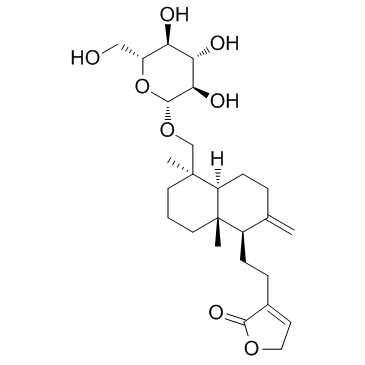 |
Neoandrographolide
CAS:27215-14-1 |
C26H40O8 |
|
Antihepatotoxic effects of major diterpenoid constituents of...
1993-07-06 [Biochem. Pharmacol. 46(1) , 182-5, (1993)] |
|
Study of anti-inflammatory activities of the pure compounds ...
2010-11-01 [Int. Immunopharmacol. 10(11) , 1361-73, (2010)] |
|
Quantitative analysis of four major diterpenoids in Androgra...
2012-11-01 [J. Pharm. Biomed. Anal. 70 , 87-93, (2012)] |
|
Inhibitory effects of neoandrographolide on nitric oxide and...
2007-04-01 [Mol. Cell Biochem. 298(1-2) , 49-57, (2007)] |
|
Microbial transformation of neoandrographolide by Aspergillu...
2007-01-01 [J. Asian Nat. Prod. Res. 9(3-5) , 463-9, (2007)] |