Effect of colchicine on hepatobiliary function in CCl4 treated rats.
C V Rao, H M Mehendale
Index: Biochem. Pharmacol. 42(12) , 2323-32, (1991)
Full Text: HTML
Abstract
A number of toxic chemicals affect the biliary excretory function of liver. Organochlorines and halomethanes are known to enhance bile flow. Despite the demonstration that a diversity of agents modify biliary function, the mechanism by which these chemicals manifest this effect is not fully understood. This study was designed to assess the effect of colchicine (0.1, 1.0, or 2.5 mg/kg, i.p., in saline) administration on biliary excretory function 6 and 24 hr later. Additionally, the effect of colchicine (1 mg/kg, i.p. in saline) pretreatment in rats 2 hr prior to the administration of a single low dose of CCl4 (100 microL/kg, i.p., in corn oil) or corn oil alone (1 mL/kg, i.p.) on hepatic biliary excretory function was also assessed at 6 and 24 hr after the last treatment. The hepatotoxicity was evaluated by serum enzymes, alanine and aspartate aminotransferases, and histopathological alterations of the liver. Biliary excretion of intravenously administered phenolphthalein glucuronide (PG) was assessed in bile duct cannulated anesthetized rats. Only the highest dose of colchicine (2.5 mg/kg) resulted in detectable liver injury as revealed by elevations of serum transaminases. While the lowest dose of colchicine (0.1 mg/kg) did not influence bile secretion, the two higher doses caused a slight choleretic effect at 24 hr. The highest dose caused a transient inhibition of bile flow, but this effect was no longer evident at 6 hr. Biliary excretion of PG was inhibited significantly by colchicine within 6 hr after administration, an effect that was also persistent at 24 hr. Colchicine at a 1 mg/kg dose did not cause any adverse effect on hepatobiliary function. Therefore, for the interactive toxicity study with CCl4, 1 mg colchicine/kg was chosen as a moderate dose which did not cause any significant adverse effect on hepatobiliary function. Biliary excretion of PG was significantly lower in rats at 6 and 24 hr after the combination treatment with colchicine + CCl4 than in rats receiving either CCl4 or colchicine alone. In contrast, rats receiving CCl4 alone or colchicine + CCl4 showed a significant increase in cumulative bile flow at 6 hr, whereas, at 24 hr, the bile flow was increased significantly in rats receiving colchicine regardless of CCl4 treatment. The data suggest that colchicine pretreatment leads to significant inhibition of hepatobiliary excretion in CCl4 treated rats. Serum alanine transaminase and aspartate transaminase levels were elevated significantly after the colchicine + CCl4 combination, indicating hepatic injury.(ABSTRACT TRUNCATED AT 400 WORDS)
Related Compounds
| Structure | Name/CAS No. | Molecular Formula | Articles |
|---|---|---|---|
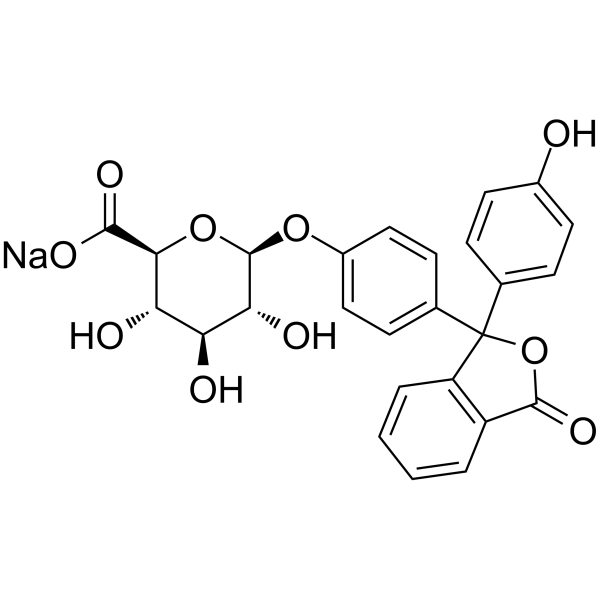 |
phenolphthalein glucuronic acid sodium salt
CAS:6820-54-8 |
C26H21NaO10 | |
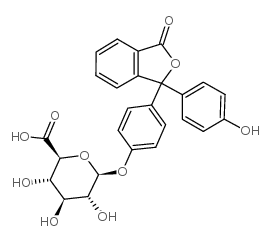 |
β-glucuronidase substrate
CAS:15265-26-6 |
C26H22O10 |
|
Deconjugation of glucuronides catalysed by UDPglucuronyltran...
1986-09-26 [Biochim. Biophys. Acta 873(2) , 252-9, (1986)] |
|
Distribution of chlordecone to liver plasma membranes and re...
1994-01-26 [Toxicology 86(1-2) , 123-34, (1994)] |
|
NMR-monitored solid-phase extraction of phenolphthalein gluc...
1991-01-01 [J. Pharm. Biomed. Anal. 9(10-12) , 895-9, (1991)] |
|
Biliary excretion of sulfated bile acids and organic anions ...
2006-01-01 [J. Gastroenterol. Hepatol. 21(1 Pt 1) , 26-31, (2006)] |
|
Application of high-performance liquid chromatography-electr...
2005-07-01 [Anal. Biochem. 342(1) , 45-52, (2005)] |