Glutamate agonist-induced hippocampal lesion and nitric oxide synthase/NADPH-diaphorase: a light and electron microscopical study in the rat.
G Wolf, G Henschke, S Würdig
Index: Neurosci. Lett. 161(1) , 49-52, (1993)
Full Text: HTML
Abstract
The 2-(2'-benzothiazolyl)-5-styryl-3-(4'-phthalhydrazidyl) tetrazolium chloride (BSPT)-tetrazolium salt technique for the electron microscopic demonstration of reduced nicotinamide adenine dinucleotide phosphate-diaphorase (NADPH-d) was used to localize nitric oxide synthase in the normal and excitotoxically lesioned rat hippocampus. The reaction product BSPT-formazan was shown to stain membranes predominantly of the endoplasmic reticulum. Apart from singular heavily labeled interneurons, the majority of neurons including pyramidal and granular cells and a few astroglial cells, light microscopically 'unstained', showed labeled membrane portions, but to a by far lesser extent. In lesioned areas some prominantly stained neurons rich in labeled membranes and surrounded by cell debris seemed to be largely preserved. An increased number of ultrahistochemically NADPH-d-stained glial cells, in particular astrocytes, was seen.
Related Compounds
| Structure | Name/CAS No. | Molecular Formula | Articles |
|---|---|---|---|
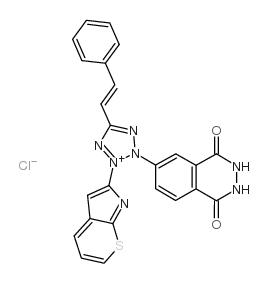 |
2-(2'-BENZOTHIAZOLYL)-5-STYRYL-3-(4'PHTHALHYDRAZIDYL)TETRAZOLIUM CHLORIDE
CAS:38116-89-1 |
C24H16ClN7O2S |
|
First determination of the inhibitor complex structure of hu...
2004-03-01 [J. Biochem. 135(3) , 279-83, (2004)] |
|
Localization of NADPH-diaphorase/nitric oxide synthase in th...
1995-09-04 [Brain Res. 690(2) , 231-5, (1995)] |
|
Localization of nitric oxide synthase in the goldfish retina...
1996-12-16 [Brain Res. 743(1-2) , 353-6, (1996)] |
|
Histiocytes X and X body reactivity with concanavalin A, pea...
1987-12-01 [Pathol. Res. Pract. 182(6) , 805-9, (1987)] |
|
Enzyme-cytochemically detectable NADPH-diaphorase activity i...
1999-01-01 [Eur. J. Histochem. 43(3) , 247-51, (1999)] |