Propylene Carbonate/Propylene carbonate
Published date: 2024-09-03 11:57:29
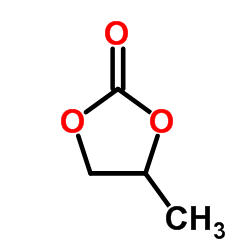


|
Name | Propylene carbonate | CAS# | 108-32-7 |
|---|---|---|---|---|
| Price | ¥Inquiry/1kg | Purity | 99.0% | |
| Stocking Period |
Inquiry | Stock | Inquiry | |
| Product Webpage: | https://xcchemico.com/product/propylene-carbonate/ | |||
| Detail
Product Information
Acrylic carbonate is a colorless, odorless, flammable liquid. It is miscible with ether, acetone, benzene, chloroform, vinyl acetate, etc., and soluble in water and carbon tetrachloride. It has strong absorption capacity for carbon dioxide and stable properties. In industry, epichlorohydrin is added to carbon dioxide under a certain pressure and then distilled under reduced pressure to produce it. Can be used as an oil solvent, spinning solvent, olefin, aromatic hydrocarbon extractant, carbon dioxide absorbent, dispersant for water-soluble dyes and pigments, etc. Product Name: Acrylic Carbonate Foreign name: Propylene carbonate Melting point: -48.8 ℃ Boiling point: 242 ℃ Relative density: 1.2047 (20/4 ℃) Refractive index: 1.4218 About Naming The Chinese standard name corresponding to Propylene Carbonate is not "propylene carbonate". Structurally, we can see that there is no unsaturated bond of "ene" (only the carbon oxygen double bond of ester), and it is a cyclic structure, while the name "propylene carbonate" does not reflect this structure. The reason for this is that the word "propylene" has two meanings: "propylene" and "propylene", and "propylene carbonate" may have been translated into Chinese based on its meaning without understanding its structure. Propylene Carbonate can be translated as propylene carbonate, propylene glycol carbonate, 1,2-propanediol carbonate, or 4-methyl-2,5-dioxo-1-one. Product Usage In the electronics industry, it can be used as an excellent medium for high-energy batteries and capacitors. In the polymer industry, it can be used as a solvent and plasticizer for polymers. Plasticizers used as adhesives and sealants. It can also be used as a curing accelerator for phenolic resins and a dispersant for water-soluble adhesive pigments and fillers. The chemical industry is the main raw material for synthesizing dimethyl carbonate and can also be used to remove carbon dioxide and hydrogen sulfide from natural gas and petroleum cracking gas· In addition, it can also be used in industrial fields such as textiles and printing and dyeing. Packaged in 200kg galvanized iron drums, or packaged according to customer requirements. Storage and transportation should be carried out in a cool, dry, and well ventilated place. Steel cylinders should be placed vertically to avoid heat and exposure to sunlight. |