1610677-37-6
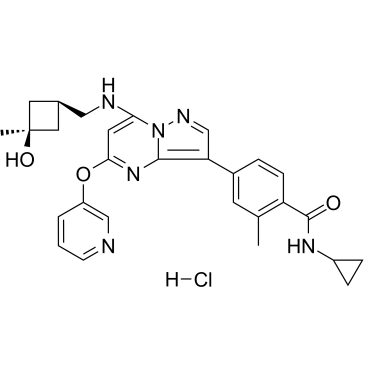
1610677-37-6 structure
- Name: CFI-402257 hydrochloride
- Chemical Name: CFI-402257 hydrochloride
- CAS Number: 1610677-37-6
- Molecular Formula: C28H31ClN6O3
- Molecular Weight: 535.04
- Catalog: Signaling Pathways Cell Cycle/DNA Damage Mps1
- Create Date: 2019-06-02 08:41:56
- Modify Date: 2026-07-03 16:26:03
-
CFI-402257 hydrochloride is a highly selective and orally bioavailable TTK/Mps1 inhibitor with an IC50s of 1.7 nM for TTK in vitro. CFI-402257 hydrochloride has anti-cancer activity[1].
| Name | CFI-402257 hydrochloride |
|---|---|
| Synonyms |
CFI-402257 HCl
N-cyclopropyl-4-(7-((((1s,3s)-3-hydroxy-3-methylcyclobutyl)methyl)amino)-5-(pyridin-3-yloxy)pyrazolo[1,5-a]pyrimidin-3-yl)-2-methylbenzamide hydrochloride Luvixasertib hydrochloride |
| Description | CFI-402257 hydrochloride is a highly selective and orally bioavailable TTK/Mps1 inhibitor with an IC50s of 1.7 nM for TTK in vitro. CFI-402257 hydrochloride has anti-cancer activity[1]. |
|---|---|
| Related Catalog | |
| Target |
IC50: 1.7 nM (TTK in vitro)[1] EC50: 6.5 nM (Mps1)[2]. |
| In Vitro | CFI-402257 is highly selective to TTK. CFI-402257 is tested against a panel of human kinases at 1 μM and inhibits none of the 262 kinases tested. CFI-402257 is a potent inhibitor of cell growth[1]. CFI-402257 (200 nM, 6 h) causes a massive increase in chromosome missegregations[2]. CFI-402257 (0, 50 or 100 nM) induces a dose-dependent dysregulation of the cell cycle, resulting in an increase in the frequency of cells exhibiting an aneuploid DNA content[2]. CFI-402257 exhibits effects consistent with Mps1 kinase inhibition, specifically SAC inactivation, leading to chromosome missegregation, aneuploidy, and ultimately cell death[2]. Cell Cycle Analysis[2] Cell Line: HCT116 cells. Concentration: 0 nM, 50 nM, 100 nM, 300 nM, 1000 nM, 3000 nM. Incubation Time: 48 hours Result: Resulted in an increase in the frequency of cells exhibiting an aneuploid DNA content. Western Blot Analysis[2] Cell Line: HCT116 cells. Concentration: 0 nM, 50 nM or 100 nM. Incubation Time: 8, 16, 24 and 48 hours. Result: CFI-402257-induced aneuploidy was accompanied by a progressive accumulation of apoptotic cells that were detectable as early as 16 h following treatment. |
| In Vivo | CFI-402257 given orally QD shows dose-dependent activity in mice with established tumors from xenografted MDA-MB-231 human TNBC cells and MDA-MB-468 human TNBC cells in mice. CFI-402257 demonstrates antitumor activity in a platinum-resistant PDX model of high-grade serous ovarian cancer[2]. Animal Model: Xenografted MDA-MB-231 human TNBC cells and MDA-MB-468 human TNBC cells in mice[2]. Dosage: 5, 6 mg/kg. Administration: Oral gavage, daily. Result: Xenografted MDA-MB-231 human TNBC cells: 5 mg/kg, tumor growth inhibition (TGI) = 74%; 6 mg/kg, TGI = 89%. Xenografted MDA-MB-468 human TNBC cells: 5 mg/kg, tumor growth inhibition (TGI) = 75%; 6 mg/kg, TGI = 94%. Animal Model: PDX model of high-grade serous ovarian cancer[2]. Dosage: 6.5, 7.5 mg/kg. Administration: Oral gavage, daily. Result: 6.5 mg/kg, tumor growth inhibition (TGI) = 61%; 7.5 mg/kg, TGI = 97%. |
| References |
| Molecular Formula | C28H31ClN6O3 |
|---|---|
| Molecular Weight | 535.04 |