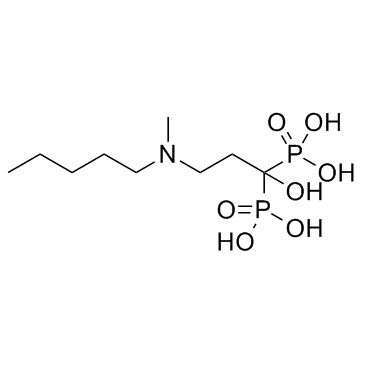
138844-81-2
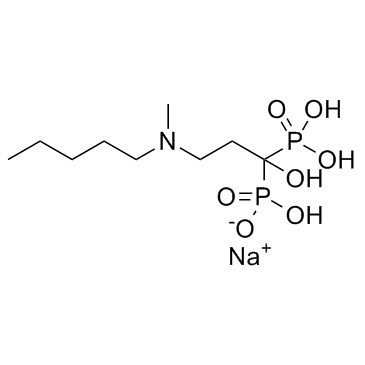
138844-81-2 structure
- Name: Ibandronate sodium
- Chemical Name: Ibandronic Acid Sodium Salt
- CAS Number: 138844-81-2
- Molecular Formula: C9H22NNaO7P2
- Molecular Weight: 341.211
- Catalog: API Water, electrolyte and acid-base balance regulator Electrolyte balance regulator
- Create Date: 2018-07-19 13:43:45
- Modify Date: 2026-07-03 16:58:28
-
Ibandronate Sodium is a highly potent nitrogen-containing bisphosphonate used for the treatment of osteoporosis.Target: OthersIbandronate (1.25-2 μM) significantly reduces endothelial cell growth, while ibandronate (2 μM) also significantly reduces capillary-like tube formation and increases apoptosis of endothelial cells. Ibandronate (< 100 μM) dose-dependently increases VEGF expression in endothelial cells [1]. Ibandronate (< 100 μM) inhibits growth of both prostate cancer cell lines (LNCaP and PC-3) in a dose dependent manner [2].Ibandronate administered either daily (2.5 mg) or intermittently (20 mg every other day for 12 doses every 3 months) significantly reduces the risk of new morphometric vertebral fractures by 62% and 50% (p = 0.0006), respectively, in osteoporotic women after 3 years' treatment. Ibandronate administered either daily (2.5 mg) or intermittently (20 mg every other day for 12 doses every 3 months) significantly and progressively increases BMD of lumbar spine by 6.5% and 5.7%, respectively, in osteoporotic women after 3 years' treatment [3]. Ibandronate (< 125 mg/kg s.c.) results in a dose dependent increase in bone mineral density (BMD), trabecular bone volume and trabecular number, load to failure (Fmax), and yield load in long bones and vertebrae in ovariectomized rats, and increased trabecular separation in ovariectomized rats is fully prevented by all doses [4].
| Name | Ibandronic Acid Sodium Salt |
|---|---|
| Synonyms |
Ibandronate sodium //BP
IbandronicAcidSodiumSal Ibandrote Sodium Anhydrous BM 21.0955Na Sodium Ibandronate > Phosphonicacid,[1-hydroxy-3-(methylpentylamino)propylidene]bis-,sodiumsalt(1:1) SodiuM Ibandronate hydrogène {1-hydroxy-3-[méthyl(pentyl)amino]-1-phosphonopropyl}phosphonate de sodium sodium,hydroxy-[1-hydroxy-3-[methyl(pentyl)amino]-1-phosphonopropyl]phosphinate Bondronat Natriumhydrogen-{1-hydroxy-3-[methyl(pentyl)amino]-1-phosphonopropyl}phosphonat Phosphonic acid, (1-hydroxy-3-(methylpentylamino)propylidene)bis-, monosodium salt (1-Hydroxy-3-(methyl(pentyl)amino)propane-1,1-diyl)diphosphonic acid monosodium salt Phosphonic acid, [1-hydroxy-3-(methylpentylamino)propylidene]bis-, sodium salt (1:1) Ibandronate sodiuM Bondronat IBANDRONATE //BP Ibandronate Sodium Anhydrous IBANDRONATE SODIUM (NON-STERILE DRUG SUBSTANCE) Ibandronate sodiumQ: What is Ibandronate sodium Q: What is the CAS Number of Ibandronate sodium Q: What is the storage condition of Ibandronate sodium Q: What e the applications of Ibandronate sodium Bondronat, (1-Hydroxy-3-(methylpentylamino)propylidene)bisphosphonic acid sodium (1-Hydroxy-3-(methylpentylamino)propylidene)bisphosphonic acid monosodium salt Phosphonic acid, P,P'-[1-hydroxy-3-(methylpentylamino)propylidene]bis-, sodium salt (1:1) sodium [1-hydroxy-1-(hydroxy-oxido-phosphoryl)-3-(methyl-pentyl-amino) propyl]phosphonic acid Sodium hydrogen {1-hydroxy-3-[methyl(pentyl)amino]-1-phosphonopropyl}phosphonate boniva phosphonic acid, [1-hydroxy-3-(methylpentylamino)propylidene]bis-, monosodium salt |
| Description | Ibandronate Sodium is a highly potent nitrogen-containing bisphosphonate used for the treatment of osteoporosis.Target: OthersIbandronate (1.25-2 μM) significantly reduces endothelial cell growth, while ibandronate (2 μM) also significantly reduces capillary-like tube formation and increases apoptosis of endothelial cells. Ibandronate (< 100 μM) dose-dependently increases VEGF expression in endothelial cells [1]. Ibandronate (< 100 μM) inhibits growth of both prostate cancer cell lines (LNCaP and PC-3) in a dose dependent manner [2].Ibandronate administered either daily (2.5 mg) or intermittently (20 mg every other day for 12 doses every 3 months) significantly reduces the risk of new morphometric vertebral fractures by 62% and 50% (p = 0.0006), respectively, in osteoporotic women after 3 years' treatment. Ibandronate administered either daily (2.5 mg) or intermittently (20 mg every other day for 12 doses every 3 months) significantly and progressively increases BMD of lumbar spine by 6.5% and 5.7%, respectively, in osteoporotic women after 3 years' treatment [3]. Ibandronate (< 125 mg/kg s.c.) results in a dose dependent increase in bone mineral density (BMD), trabecular bone volume and trabecular number, load to failure (Fmax), and yield load in long bones and vertebrae in ovariectomized rats, and increased trabecular separation in ovariectomized rats is fully prevented by all doses [4]. |
|---|---|
| Related Catalog | |
| References |
| Boiling Point | 587.8ºC at 760 mmHg |
|---|---|
| Molecular Formula | C9H22NNaO7P2 |
| Molecular Weight | 341.211 |
| Flash Point | 309.3ºC |
| Exact Mass | 341.076904 |
| PSA | 160.98000 |
| LogP | 0.93820 |
| Appearance | white |
| Vapour Pressure | 2.88E-16mmHg at 25°C |
| Storage condition | 2-8°C |
| Water Solubility | H2O: >10mg/mL |
| RIDADR | NONH for all modes of transport |
|---|---|
| RTECS | SZ8563300 |
|
~%
138844-81-2 |
| Literature: WO2006/2348 A2, ; Page/Page column 45 ; |