Delmitide acetate
Modify Date: 2025-08-31 16:12:40
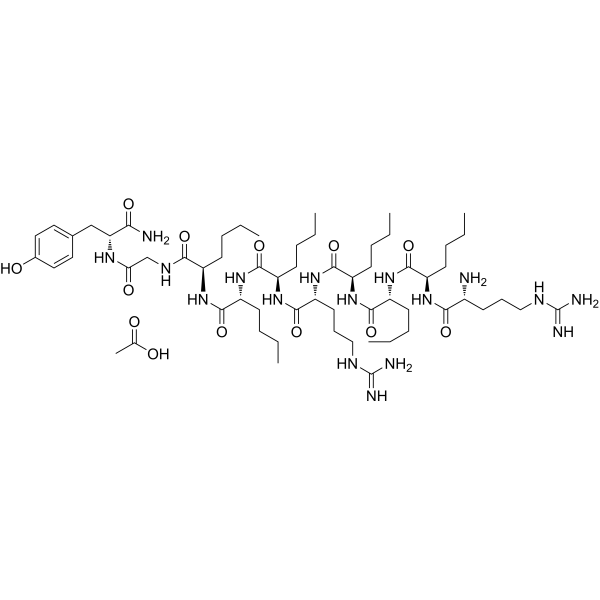
Delmitide acetate structure
|
Common Name | Delmitide acetate | ||
|---|---|---|---|---|
| CAS Number | 501019-16-5 | Molecular Weight | 1288.62 | |
| Density | N/A | Boiling Point | N/A | |
| Molecular Formula | C59H105N17O11.C2H4O2 | Melting Point | N/A | |
| MSDS | N/A | Flash Point | N/A | |
Use of Delmitide acetateDelmitide (RDP58) acetate is an orally active d-isomer decapeptide with potent anti-inflammatory activity. Delmitide acetate inhibits production of TNF-α, IFN-γ, and interleukin (IL)-12, and up-regulates heme oxygenase 1 activity. Delmitide acetate can be used for the research of ulcerative colitis[1][2]. |
| Name | Delmitide acetate |
|---|
| Description | Delmitide (RDP58) acetate is an orally active d-isomer decapeptide with potent anti-inflammatory activity. Delmitide acetate inhibits production of TNF-α, IFN-γ, and interleukin (IL)-12, and up-regulates heme oxygenase 1 activity. Delmitide acetate can be used for the research of ulcerative colitis[1][2]. |
|---|---|
| Related Catalog | |
| In Vivo | Delmitide acetate (oral; 2.5, 5, 10 mg/kg; daily) significantly reduced CPT-11induced diarrhea, mucosal inflammation, and mortality in mice by suppressing the overproduction of proinflammatory cytokines TNF-a, IFN-y, and IL-12 in vivo[2]. Delmitide acetate (oral; 2.5, 5, 10 mg/kg; daily) generates an enhanced tumor response and prolongation of time to relapse without concomitant Gl toxicity in mice[2]. |
| References |
| Molecular Formula | C59H105N17O11.C2H4O2 |
|---|---|
| Molecular Weight | 1288.62 |
| InChIKey | LTDMAMSELCSERL-XCQJOGLYSA-N |
| SMILES | CC(=O)O.CCCCC(NC(=O)C(N)CCCN=C(N)N)C(=O)NC(CCCC)C(=O)NC(CCCC)C(=O)NC(CCCN=C(N)N)C(=O)NC(CCCC)C(=O)NC(CCCC)C(=O)NC(CCCC)C(=O)NCC(=O)NC(Cc1ccc(O)cc1)C(N)=O |