Lucanthone hydrochloride
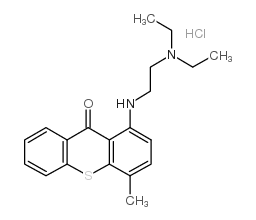
Lucanthone hydrochloride structure
|
Common Name | Lucanthone hydrochloride | ||
|---|---|---|---|---|
| CAS Number | 548-57-2 | Molecular Weight | 376.94 | |
| Density | N/A | Boiling Point | 512.4ºC at 760 mmHg | |
| Molecular Formula | C20H25ClN2OS | Melting Point | 195-196ºC | |
| MSDS | N/A | Flash Point | 263.7ºC | |
Use of Lucanthone hydrochlorideLucanthone hydrochloride is an endonuclease inhibitor of Apurinic endonuclease-1 (APE-1). |
This table lists Chinese names, IUPAC names and various aliases of this chemical substance.
| Name | lucanthone hydrochloride |
|---|---|
| Synonym | More Synonyms |
This table contains bioactivity, target information and biological‑assay experimental data of this compound.
| Description | Lucanthone hydrochloride is an endonuclease inhibitor of Apurinic endonuclease-1 (APE-1). |
|---|---|
| Related Catalog | |
| Target |
APE-1[1] |
| In Vitro | Lucanthone hydrochloride is a novel inhibitor of autophagy that induces cathepsin D-mediated apoptosis. To investigate the anticancer activity of Lucanthone hydrochloride, cell viability is measured by MTT assay. Lucanthone hydrochloride reduces cell viability to a similar extent in a panel of seven breast cancer cell lines. In addition, a direct comparison reveals that Lucanthone hydrochloride is significantly more potent than Chloroquine (CQ) at reducing breast cancer cell viability with a mean IC50 of 7.2 μM versus 66 μM for CQ. Measurement of cell viability in two representative cell lines (MDA-MB-231 and BT-20) by ATPlite assay and trypan blue exclusion reveals comparable results[2]. |
| References |
This table shows physicochemical parameters including melting point, boiling point, density, solubility and optical rotation. Missing data is marked as N/A.
| Boiling Point | 512.4ºC at 760 mmHg |
|---|---|
| Melting Point | 195-196ºC |
| Molecular Formula | C20H25ClN2OS |
| Molecular Weight | 376.94 |
| Flash Point | 263.7ºC |
| Exact Mass | 376.13800 |
| PSA | 60.58000 |
| LogP | 5.35180 |
| InChIKey | LAOOXBLMIJHMFO-UHFFFAOYSA-N |
| SMILES | CCN(CC)CCNc1ccc(C)c2sc3ccccc3c(=O)c12.Cl |
This table summarizes toxicological test data, acute & chronic toxicity and ecological hazard parameters for this chemical.
CHEMICAL IDENTIFICATION
HEALTH HAZARD DATAACUTE TOXICITY DATA
MUTATION DATA
|
This table covers safety warnings, protective measures, incompatible substances and disposal guidelines for this compound.
| HS Code | 2932999099 |
|---|
This table shows customs‑related data including HS‑code, tariff and regulatory conditions for import and export.
| HS Code | 2932999099 |
|---|---|
| Summary | 2932999099. other heterocyclic compounds with oxygen hetero-atom(s) only. VAT:17.0%. Tax rebate rate:13.0%. . MFN tariff:6.5%. General tariff:20.0% |
This table collects all English aliases, systematic names and CAS‑related synonyms of the compound.
| 1-(2-Diaethylamino-aethylamino)-4-methyl-thioxanthen-9-on,Hydrochlorid |
| 1-(2-Diethylamino-ethylamino)-4-methylthiaxanthon,Lucanthon |
| Lycanthone |
| 1-(2-diethylamino-ethylamino)-4-methyl-thioxanthen-9-one,hydrochloride |
| thioxanthone |
| 1-(2-diethylamino-ethylamino)-4-methyl-thioxanthen-9-one |
| 1-<2-Diaethylamino-aethylamino>-4-methyl-thioxanthenon-(9) |
| 1-[[2-(Diethylamino)ethyl]amino]-4-methyl-9H-thioxanthen-9-one |
| 1-(2-Diaethylamino-aethylamino)-4-methyl-thioxanthen-9-on |
This section contains frequently‑asked‑questions about this compound, including basic parameters, properties, storage conditions and corresponding answers.
| Q: What is the molecular weight of lucanthone hydrochloride? |
| A: Molecular weight of lucanthone hydrochloride is 376.94. |
| Q: What is the SMILES notation of lucanthone hydrochloride? |
| A: SMILES notation of lucanthone hydrochloride is CCN(CC)CCNc1ccc(C)c2sc3ccccc3c(=O)c12.Cl. |
| Q: What is the CAS number of lucanthone hydrochloride? |
| A: CAS number of lucanthone hydrochloride is 548-57-2. |
| Q: What is the boiling point of lucanthone hydrochloride? |
| A: Boiling point of lucanthone hydrochloride is 512.4ºC at 760 mmHg. |
| Q: What are the uses of lucanthone hydrochloride? |
| A: Main uses of lucanthone hydrochloride: Lucanthone hydrochloride is an endonuclease inhibitor of Apurinic endonuclease-1 (APE-1). |
| Q: What is the English name of lucanthone hydrochloride? |
| A: The English name of lucanthone hydrochloride is lucanthone hydrochloride. |
| Q: What is the molecular formula of lucanthone hydrochloride? |
| A: Molecular formula of lucanthone hydrochloride is C20H25ClN2OS. |
| Q: What is the InChIKey of lucanthone hydrochloride? |
| A: InChIKey of lucanthone hydrochloride is LAOOXBLMIJHMFO-UHFFFAOYSA-N. |
| Q: What is the melting point of lucanthone hydrochloride? |
| A: Melting point of lucanthone hydrochloride is 195-196ºC. |
| Q: What is the LogP of lucanthone hydrochloride? |
| A: LogP of lucanthone hydrochloride is 5.35180. |
This table lists manufacturers and suppliers of this compound, including vendor names and product supply reference information.
| Shanghai Nianxing Industrial Co., Ltd |
| Dayang Chem (Hangzhou) Co., Ltd. |