O-(4-hydroxy-3-iodophenyl)-3,5-diiodo-L-tyrosine hydrochloride
Modify Date: 2026-07-07 16:04:39
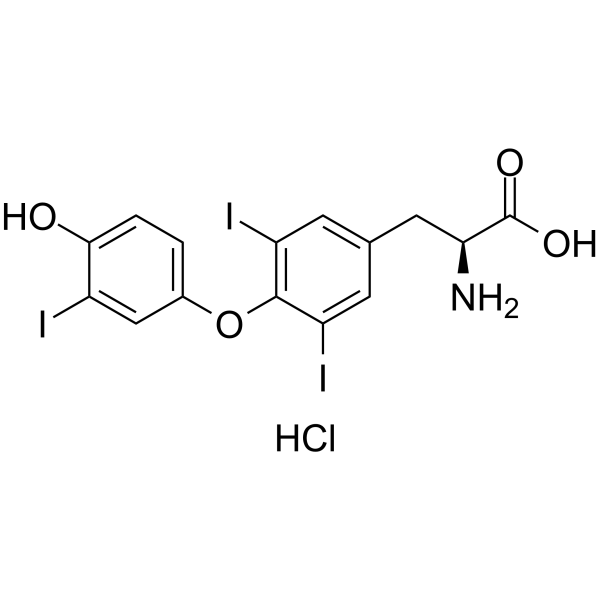
O-(4-hydroxy-3-iodophenyl)-3,5-diiodo-L-tyrosine hydrochloride structure
|
Common Name | O-(4-hydroxy-3-iodophenyl)-3,5-diiodo-L-tyrosine hydrochloride | ||
|---|---|---|---|---|
| CAS Number | 6138-47-2 | Molecular Weight | 687.43400 | |
| Density | N/A | Boiling Point | N/A | |
| Molecular Formula | C15H13ClI3NO4 | Melting Point | N/A | |
| MSDS | N/A | Flash Point | N/A | |
Use of O-(4-hydroxy-3-iodophenyl)-3,5-diiodo-L-tyrosine hydrochlorideLiothyronine hydrochloride is an active form of thyroid hormone. Liothyronine hydrochloride is a potent thyroid hormone receptors TRα and TRβ agonist with Kis of 2.33 nM for hTRα and hTRβ, respectively[1][2][3]. |
| Name | (2S)-2-amino-3-[4-(4-hydroxy-3-iodophenoxy)-3,5-diiodophenyl]propanoic acid,hydrochloride |
|---|---|
| Synonym | More Synonyms |
| Description | Liothyronine hydrochloride is an active form of thyroid hormone. Liothyronine hydrochloride is a potent thyroid hormone receptors TRα and TRβ agonist with Kis of 2.33 nM for hTRα and hTRβ, respectively[1][2][3]. |
|---|---|
| Related Catalog | |
| Target |
Human Endogenous Metabolite |
| In Vitro | Liothyronine (T3, 100 nM) hydrochloride stimulates the proliferation of hepatocarcinema cells in which TRβ1 is overexpressed[1]. Liothyronine hydrochloride binds to human β1 thyroid hormone receptor (hTRβ1), and changes its conformation. Liothyronine hydrochloride promotes growth, induces differentiation and regualtes metabolic effects[2]. |
| References |
| Molecular Formula | C15H13ClI3NO4 |
|---|---|
| Molecular Weight | 687.43400 |
| Exact Mass | 686.76700 |
| PSA | 92.78000 |
| LogP | 5.45500 |
| InChIKey | HFEMPWKWYHWPQX-YDALLXLXSA-N |
| SMILES | Cl.NC(Cc1cc(I)c(Oc2ccc(O)c(I)c2)c(I)c1)C(=O)O |
| Liothyronine hydrochloride |
| trionine |
| Liothyronine HCl |
| Thyrotradin (TN) |
| EINECS 228-120-0 |