Stochastic Measurement Models for Quantifying Lymphocyte Responses Using Flow Cytometry.
Andrey Kan, Damian Pavlyshyn, John F Markham, Mark R Dowling, Susanne Heinzel, Jie H S Zhou, Julia M Marchingo, Philip D Hodgkin
文献索引:PLoS ONE 11 , e0146227, (2016)
全文:HTML全文
摘要
Adaptive immune responses are complex dynamic processes whereby B and T cells undergo division and differentiation triggered by pathogenic stimuli. Deregulation of the response can lead to severe consequences for the host organism ranging from immune deficiencies to autoimmunity. Tracking cell division and differentiation by flow cytometry using fluorescent probes is a major method for measuring progression of lymphocyte responses, both in vitro and in vivo. In turn, mathematical modeling of cell numbers derived from such measurements has led to significant biological discoveries, and plays an increasingly important role in lymphocyte research. Fitting an appropriate parameterized model to such data is the goal of these studies but significant challenges are presented by the variability in measurements. This variation results from the sum of experimental noise and intrinsic probabilistic differences in cells and is difficult to characterize analytically. Current model fitting methods adopt different simplifying assumptions to describe the distribution of such measurements and these assumptions have not been tested directly. To help inform the choice and application of appropriate methods of model fitting to such data we studied the errors associated with flow cytometry measurements from a wide variety of experiments. We found that the mean and variance of the noise were related by a power law with an exponent between 1.3 and 1.8 for different datasets. This violated the assumptions inherent to commonly used least squares, linear variance scaling and log-transformation based methods. As a result of these findings we propose a new measurement model that we justify both theoretically, from the maximum entropy standpoint, and empirically using collected data. Our evaluation suggests that the new model can be reliably used for model fitting across a variety of conditions. Our work provides a foundation for modeling measurements in flow cytometry experiments thus facilitating progress in quantitative studies of lymphocyte responses.
相关化合物
| 结构式 | 名称/CAS号 | 分子式 | 全部文献 |
|---|---|---|---|
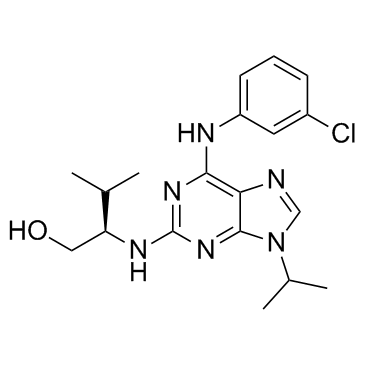 |
Purvalanol A.
CAS:212844-53-6 |
C19H25ClN6O |
|
Phosphoproteomic Analysis of Aurora Kinase Inhibition in Mon...
2015-09-04 [J. Proteome Res. 14 , 4087-98, (2015)] |
|
Involvement of atypical transcription factor E2F8 in the pol...
2015-01-01 [Cell Cycle 14 , 1842-58, (2015)] |
|
KAP regulates ROCK2 and Cdk2 in an RNA-activated glioblastom...
2015-03-12 [Oncogene 34(11) , 1432-41, (2015)] |
|
Placental passage of olomoucine II, but not purvalanol A, is...
2016-01-01 [Xenobiotica 46 , 416-23, (2016)] |
|
Phosphorylation of the centrosomal protein, Cep169, by Cdk1 ...
2015-12-25 [Biochem. Biophys. Res. Commun. 468 , 642-6, (2015)] |