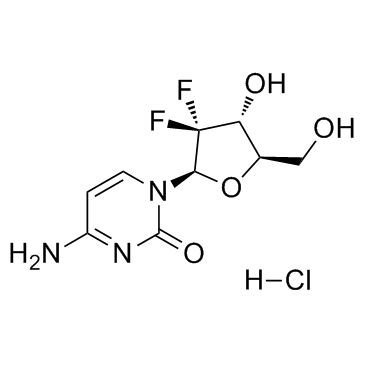
gemcitabine hydrochloride
更新时间:2018-07-16 10:04:49
| 常用名 | 盐酸吉西他滨 | CAS号 | 122111-03-9 |
|---|---|---|---|
| 价格 | $需询单/1kg | 纯度 | 99.9% |
| 备货期 | 需询单 | 库存 | 现货 |
| 产品详情(用途,包装等)
Names [ Name ]: gemcitabine hydrochloride [ Synonym ]: More Synonyms Chemical & Physical Properties [ Boiling Point ]: 482.7ºC at 760 mmHg [ Melting Point ]: >250°C dec. [ Molecular Formula ]: C9H12ClF2N3O4 [ Molecular Weight ]: 299.659 [ Exact Mass ]: 299.048431 [ PSA ]: 110.60000 [ LogP ]: 0.09460 [ Vapour Pressure ]: 2.41E-11mmHg at 25°C MSDS Section I.Chemical Product and Company Identification Chemical Name Gemcitabine Hydrochloride
Portland OR SynonymCytidine, 2'-deoxy-2',2'-difluoro-, hydrochloride (1:1) (CA INDEX NAME) Chemical FormulaC9H11F2N3O4 · HCl CAS Number122111-03-9 Section II. Composition and Information on Ingredients Toxicology Data Chemical NameCAS Number Percent (%)TLV/PEL Min. 98.0 Not available.Rat LD50 (intravenous) 236 mg/kg Gemcitabine Hydrochloride122111-03-9 (HPLC,N)Mouse LD50 (intravenous) 500 mg/kg Section III. Hazards Identification Irritating to eyes and skin on contact. Inhalation causes irritation of the lungs and respiratory system. Inflammation of the Acute Health Effects eye is characterized by redness, watering, and itching. Skin inflammation is characterized by itching, scaling, reddening, or, occasionally, blistering. Follow safe industrial hygiene practices and always wear proper protective equipment when handling this compound. CARCINOGENIC EFFECTS : Not available. Chronic Health Effects MUTAGENIC EFFECTS : Not available. TERATOGENIC EFFECTS : Not available. DEVELOPMENTAL TOXICITY: Reproductive effects. Mouse TDLo Intravenous 15 mg/kg, female 6-15 days of pregnancy Toxic Effects: Maternal Effects - Parturition Effects on Fertility - Post-implantation mortality Effects on Fertility - Litter size Mouse TDLo Intravenous 15 mg/kg, female 6-15 days of pregnancy Toxic Effects: Maternal Effects - Other effects Effects on Embryo or Fetus - Fetotoxicity Effects on Embryo or Fetus - Fetal death Repeated or prolonged exposure to this compound is not known to aggravate existing medical conditions. Section IV. First Aid Measures Eye ContactCheck for and remove any contact lenses. In case of contact, immediately flush eyes with plenty of water for at least 15 minutes. Get medical attention. Skin ContactIn case of contact, immediately flush skin with plenty of water. Remove contaminated clothing and shoes. Wash clothing before reuse. Thoroughly clean shoes before reuse. Get medical attention. If the victim is not breathing, perform mouth-to-mouth resuscitation. Loosen tight clothing such as a collar, tie, belt or Inhalation waistband. If breathing is difficult, oxygen can be administered. Seek medical attention if respiration problems do not improve. INDUCE VOMITING by sticking finger in throat. Lower the head so that the vomit will not reenter the mouth and throat. Ingestion Loosen tight clothing such as a collar, tie, belt or waistband. If the victim is not breathing, perform mouth-to-mouth resuscitation. Examine the lips and mouth to ascertain whether the tissues are damaged, a possible indication that the toxic material was ingested; the absence of such signs, however, is not conclusive. Section V. Fire and Explosion Data Not available. May be combustible at high temperature.Auto-Ignition Flammability Flash PointsFlammable LimitsNot available. Not available. These products are toxic carbon oxides (CO, CO2), nitrogen oxides (NO, NO2), halogenated compounds. Combustion Products WARNING: Highly toxic HCl gas is produced during combustion. WARNING: Highly toxic HF gas is produced during combustion. Fire Hazards Not available. Continued on Next Page Gemcitabine Hydrochloride Explosion HazardsRisks of explosion of the product in presence of mechanical impact: Not available. Risks of explosion of the product in presence of static discharge: Not available. Fire Fighting MediaSMALL FIRE: Use DRY chemical powder. LARGE FIRE: Use water spray, fog or foam. DO NOT use water jet. and Instructions Consult with local fire authorities before attempting large scale fire-fighting operations. Section VI. Accidental Release Measures Spill CleanupIrritating material. This material is a reproductive effector. Use a shovel to put the material into a convenient waste disposal container. Consult federal, state, and/or local authorities for Instructions assistance on disposal. Section VII. Handling and Storage IRRITANT. REPRODUCTIVE EFFECTOR. Keep away from heat. Mechanical exhaust required. When not in use, tightly Handling and Storage seal the container and store in a dry, cool place. Avoid excessive heat and light. Do not breathe dust. Information Always store away from incompatible compounds such as oxidizing agents. Section VIII. Exposure Controls/Personal Protection Engineering ControlsUse process enclosures, local exhaust ventilation, or other engineering controls to keep airborne levels below recommended exposure limits. If user operations generate dust, fume or mist, use ventilation to keep exposure to airborne contaminants below the exposure limit. Personal ProtectionSplash goggles. Lab coat. Dust respirator. Boots. Gloves. Suggested protective clothing might not be sufficient; consult a specialist BEFORE handling this product. Be sure to use a MSHA/NIOSH approved respirator or equivalent. Not available. Exposure Limits Section IX. Physical and Chemical Properties Physical state @ 20°CSolid. (White crystalline powder.)SolubilitySoluble in hot water. Not available. Specific Gravity Molecular Weight299.66Partition CoefficientNot available. Boiling PointNot available.Not applicable. Vapor Pressure Melting Point287 to 292°C (548.6 to 557.6°F) (dec.)Vapor DensityNot available. Not available.Not available. Refractive IndexVolatility Critical TemperatureNot available.OdorNot available. Not available.Not available. ViscosityTaste Section X. Stability and Reactivity Data This material is stable if stored under proper conditions. (See Section VII for instructions) Stability Conditions of InstabilityAvoid excessive heat and light. IncompatibilitiesReactive with oxidizing agents. Section XI. Toxicological Information RTECS NumberHA3840000 Eye Contact. Ingestion. Inhalation. Routes of Exposure Rat LD50 (intravenous) 236 mg/kg Toxicity Data Mouse LD50 (intravenous) 500 mg/kg CARCINOGENIC EFFECTS : Not available. Chronic Toxic Effects MUTAGENIC EFFECTS : Not available. TERATOGENIC EFFECTS : Not available. DEVELOPMENTAL TOXICITY: Reproductive effects. Mouse TDLo Intravenous 15 mg/kg, female 6-15 days of pregnancy Toxic Effects: Maternal Effects - Parturition Effects on Fertility - Post-implantation mortality Effects on Fertility - Litter size Mouse TDLo Intravenous 15 mg/kg, female 6-15 days of pregnancy Toxic Effects: Maternal Effects - Other effects Effects on Embryo or Fetus - Fetotoxicity Effects on Embryo or Fetus - Fetal death Repeated or prolonged exposure to this compound is not known to aggravate existing medical conditions. Continued on Next Page Gemcitabine Hydrochloride Acute Toxic EffectsIrritating to eyes and skin on contact. Inhalation causes irritation of the lungs and respiratory system. Inflammation of the eye is characterized by redness, watering, and itching. Skin inflammation is characterized by itching, scaling, reddening, or, occasionally, blistering. Follow safe industrial hygiene practices and always wear proper protective equipment when handling this compound. Section XII. Ecological Information Not available. Ecotoxicity Environmental FateNot available. Section XIII. Disposal Considerations Recycle to process, if possible. Consult your local regional authorities. You may be able to dissolve or mix material with a Waste Disposal combustible solvent and burn in a chemical incinerator equipped with an afterburner and scrubber system. Observe all federal, state and local regulations when disposing of the substance. Section XIV. Transport Information DOT ClassificationNot a DOT controlled material (United States). PIN NumberNot applicable. Proper Shipping NameNot applicable. Packing Group (PG)Not applicable. DOT Pictograms Section XV. Other Regulatory Information and Pictograms TSCA Chemical InventoryThis product is NOT on the EPA Toxic Substances Control Act (TSCA) inventory. The following notices are required by 40 CFR 720.36 (C) for those products not on the inventory list: (EPA) (i) These products are supplied solely for use in research and development by or under the supervision of a technically qualified individual as defined in 40 CFR 720.0 et sec. (ii) The health risks of these products have not been fully determined. Any information that is or becomes available will be supplied on an MSDS sheet. WHMIS ClassificationNot available. (Canada) EINECS Number (EEC) 601-823-3 EEC Risk StatementsR36/37/38- Irritating to eyes, respiratory system and skin. R60- May impair fertility. R61- May cause harm to the unborn child. SECTION 16 - ADDITIONAL INFORMATION N/A Toxicological Information CHEMICAL IDENTIFICATION RTECS NUMBER : HA3840000 CHEMICAL NAME : Cytidine, 2'-deoxy-2',2'-difluoro-, monohydrochloride CAS REGISTRY NUMBER : 122111-03-9 LAST UPDATED : 199706 DATA ITEMS CITED : 2 MOLECULAR FORMULA : C9-H11-F2-N3-O4.Cl-H MOLECULAR WEIGHT : 299.69 HEALTH HAZARD DATA ACUTE TOXICITY DATA TYPE OF TEST : TDLo - Lowest published toxic dose ROUTE OF EXPOSURE : Intravenous DOSE : 15 mg/kg SEX/DURATION : female 6-15 day(s) after conception TOXIC EFFECTS : Reproductive - Maternal Effects - parturition Reproductive - Fertility - post-implantation mortality (e.g. dead and/or resorbed implants per total number of implants) Reproductive - Fertility - litter size (e.g. # fetuses per litter; measured before birth) REFERENCE : TJADAB Teratology, The International Journal of Abnormal Development. (Alan R. Liss, Inc., 41 E. 11th St., New York, NY 10003) V.1- 1968- Volume(issue)/page/year: 48,365,1993 TYPE OF TEST : TDLo - Lowest published toxic dose ROUTE OF EXPOSURE : Intravenous DOSE : 15 mg/kg SEX/DURATION : female 6-15 day(s) after conception TOXIC EFFECTS : Reproductive - Maternal Effects - other effects Reproductive - Effects on Embryo or Fetus - fetotoxicity (except death, e.g., stunted fetus) Reproductive - Effects on Embryo or Fetus - fetal death REFERENCE : TJADAB Teratology, The International Journal of Abnormal Development. (Alan R. Liss, Inc., 41 E. 11th St., New York, NY 10003) V.1- 1968- Volume(issue)/page/year: 48,365,1993 Safety Information [ Symbol ]: GHS08 GHS08 [ Signal Word ]: Danger [ Hazard Statements ]: H360 [ Precautionary Statements ]: P201-P280-P308 + P313 [ Hazard Codes ]: Xi: Irritant; [ Risk Phrases ]: R21 [ Safety Phrases ]: 25-26-36/37-53 [ RIDADR ]: NONH for all modes of transport [ HS Code ]: 2934999090 Synthetic RoutePrevious 1/2 Next Gemcitabine结构式 CAS#:95058-81-4 Gemcitabine ~89% gemcitabine hydrochloride Structure CAS#:122111-03-9 gemcitabine hyd... Literature: Hanmi Pharm. Co.,Ltd Patent: US2007/249818 A1, 2007 ; Location in patent: Page/Page column 10 ; 2-Deoxy-2,2-difluoro-D-ribofuranose-3,5-di benzoate结构式 CAS#:1173824-58-2 2-Deoxy-2,2-dif... N-trimethylsilyl-N-(2-trimethylsilyloxypyrimidin-4-yl)acetamide结构式 CAS#:18027-23-1 N-trimethylsily... ~51% gemcitabine hydrochloride Structure CAS#:122111-03-9 gemcitabine hyd... Literature: KANNAN, Vishwanath; KASH, Vishwanathan Patent: WO2010/29574 A2, 2010 ; Location in patent: Page/Page column 8-9 ; 2'-deoxy-2',2'-difluorocytidines结构式 CAS#:103882-84-4 2'-deoxy-2',2'-... ~% 4-amino-1-[(2S,4S,5R)-3,3-difluoro-4-hydroxy-5-(hydroxymethyl)oxolan-2-yl]pyrimidin-2-one,hydrochloride结构式 CAS#:122111-05-1 4-amino-1-[(2S,... gemcitabine hydrochloride Structure CAS#:122111-03-9 gemcitabine hyd... Literature: WO2007/117760 A2, ; Page/Page column 21 ; Precursor & DownStream Precursor 6 Previous 1/2 Next Gemcitabine Structure CAS#:95058-81-4 Gemcitabine 2-Deoxy-2,2-difluoro-D-ribofuranose-3,5-di benzoate Structure CAS#:1173824-58-2 2-Deoxy-2,2-dif... N-trimethylsilyl-N-(2-trimethylsilyloxypyrimidin-4-yl)acetamide Structure CAS#:18027-23-1 N-trimethylsily... 2'-deoxy-2',2'-difluorocytidines Structure CAS#:103882-84-4 2'-deoxy-2',2'-... DownStream 4 [(2R,5R)-3-benzoyloxy-5-(2,4-dioxopyrimidin-1-yl)-4,4-difluorooxolan-2-yl]methyl benzoate structure CAS#:143157-27-1 [(2R,5R)-3-benz... Gemcitabine structure CAS#:95058-81-4 Gemcitabine 2',2'-Difluoro-2'-deoxyuridine structure CAS#:114248-23-6 2',2'-Difluoro-... 2'-Deoxy-3',5'-bis-O-[dimethyl(2-methyl-2-propanyl)silyl]-2',2'-d ifluorocytidine structure CAS#:688009-09-8 2'-Deoxy-3',5'-... Customs [ HS Code ]: 2934999090 [ Summary ]: 2934999090. other heterocyclic compounds. VAT:17.0%. Tax rebate rate:13.0%. . MFN tariff:6.5%. General tariff:20.0% Articles27More Articles Quantitative proteomics of the yeast Hsp70/Hsp90 interactomes during DNA damage reveal chaperone-dependent regulation of ribonucleotide reductase. J. Proteomics 112 , 285-300, (2015) The highly conserved molecular chaperones Hsp90 and Hsp70 are indispensible for folding and maturation of a significant fraction of the proteome, including many proteins involved in signal transductio... Detail Co-delivery of paclitaxel and gemcitabine via CD44-targeting nanocarriers as a prodrug with synergistic antitumor activity against human biliary cancer. Biomaterials 53 , 763-74, (2015) Multi-drug delivery focuses on different signaling pathways in cancer cells that have synergistic anti-proliferative effects. In this study, we developed multi-prodrug nanocarriers (MPDNCs) consisting... Detail Systemic delivery of microencapsulated 3-bromopyruvate for the therapy of pancreatic cancer. Clin. Cancer Res. 20(24) , 6406-17, (2014) This study characterized the therapeutic efficacy of a systemically administered formulation of 3-bromopyruvate (3-BrPA), microencapsulated in a complex with β-cyclodextrin (β-CD), using an orthotopic... Detail Synonyms dFdC,Gemzar,Lilly) MFCD01735988 dFdC Gemzar (Lilly) LY-188011 dFdC dFdCyd 4-Amino-1-[(2R,4R,5R)-3,3-difluoro-4-hydroxy-5-(hydroxymethyl)tetrahydrofuran-2-yl]pyrimidin-2(1H)-one hydrochloride Gemcitabine hydrochloride 2'-Deoxy-2',2'-difluorocytidine 4-Amino-1-[(2R,4R,5R)-3,3-difluoro-4-hydroxy-5-(hydroxymethyl)tetrahydro-2-furanyl]-2(1H)-pyrimidinone hydrochloride Cytidine, 2'-deoxy-2',2'-difluoro-, hydrochloride (1:1) 2'-Deoxy-2',2'-difluorocytidine hydrochloride (1:1) Gemcitabine HCl Gemcitabine HCl(TABINES) 更多
|
- 上海阿拉丁生化科技股份有限公司
- 上海市 上海市 浦东新区
- 产品名:盐酸吉西他滨
- 价格: ¥239.9/1ml ¥37.9/10mg ¥81.9/250mg ¥57.9/50mg
- 纯度:98.0%
- 备货期:1天
- 联系人:阿拉丁

 2881459338
复制
2881459338
复制
- 盼得(上海)国际贸易有限公司
- 上海市 上海市 徐汇区
- 产品名:盐酸吉西他滨
- 价格: ¥需询单/500g ¥需询单/1kg ¥需询单/25kg ¥需询单/200kg
- 纯度:0.0%
- 备货期:需询单
- 联系人:叶经理
1710932455
复制
- 苏州市森菲达化工有限公司
- 江苏省 苏州市 相城区
- 产品名:盐酸吉西他滨
- 价格: ¥需询单/200kg
- 纯度:98.0%
- 备货期:需询单
- 联系人:程经理
3912721726
复制


 18796480002
复制
18796480002
复制

- 上海化源世纪贸易有限公司
- 上海市 上海市 普陀区
- 产品名:4-氨基-1-((2R,4R,5R)-3,3-二氟-4-羟基-5-(羟甲基)四氢呋喃-2-基)嘧啶-2(1H)-酮盐酸盐
- 价格:
- 纯度:99.0%
- 备货期:10天
- 联系人:徐经理
351666998
复制
 133 1186 9306
复制
133 1186 9306
复制

查看所有供应商和价格请点击:
参考价格:$66/10mM*1mLinWater