Photochemistry and photophysics of MOFs: steps towards MOF-based sensing enhancements
Ekaterina A. Dolgopolova, Allison M. Rice, Corey R. Martin, Natalia B. Shustova
Index: 10.1039/C7CS00861A
Full Text: HTML
Abstract
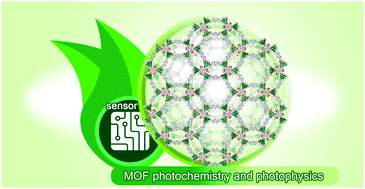
In this review, we highlight how recent advances achieved in the fields of photochemistry and photophysics of metal–organic frameworks (MOFs) could be applied towards the engineering of next generation MOF-based sensing devices. In addition to high surface area and structural tunability, which are crucial for efficient sensor development, progress in the field of MOF-based sensors could rely on the combination of MOF light-harvesting ability, understanding energy transfer processes within a framework, and application of MOF-based photocatalysis towards sensing enhancement. All photophysical concepts could be integrated within one material to improve efficiency and selectivity of sensing devices. Thus, the focus of this review is shifted towards a “beyond the pores” approach, which could foreshadow new guidelines for sensor engineering.