JaCVAM-organized international validation study of the in vivo rodent alkaline comet assay for detection of genotoxic carcinogens: II. Summary of definitive validation study results.
Yoshifumi Uno, Hajime Kojima, Takashi Omori, Raffaella Corvi, Masamistu Honma, Leonard M Schechtman, Raymond R Tice, Carol Beevers, Marlies De Boeck, Brian Burlinson, Cheryl A Hobbs, Sachiko Kitamoto, Andrew R Kraynak, James McNamee, Yuzuki Nakagawa, Kamala Pant, Ulla Plappert-Helbig, Catherine Priestley, Hironao Takasawa, Kunio Wada, Uta Wirnitzer, Norihide Asano, Patricia A Escobar, David Lovell, Takeshi Morita, Madoka Nakajima, Yasuo Ohno, Makoto Hayashi
Index: Mutat. Res. Genet. Toxicol. Environ. Mutagen. 786-788 , 45-76, (2015)
Full Text: HTML
Abstract
The in vivo rodent alkaline comet assay (comet assay) is used internationally to investigate the in vivo genotoxic potential of test chemicals. This assay, however, has not previously been formally validated. The Japanese Center for the Validation of Alternative Methods (JaCVAM), with the cooperation of the U.S. NTP Interagency Center for the Evaluation of Alternative Toxicological Methods (NICEATM)/the Interagency Coordinating Committee on the Validation of Alternative Methods (ICCVAM), the European Centre for the Validation of Alternative Methods (ECVAM), and the Japanese Environmental Mutagen Society/Mammalian Mutagenesis Study Group (JEMS/MMS), organized an international validation study to evaluate the reliability and relevance of the assay for identifying genotoxic carcinogens, using liver and stomach as target organs. The ultimate goal of this exercise was to establish an Organisation for Economic Co-operation and Development (OECD) test guideline. The study protocol was optimized in the pre-validation studies, and then the definitive (4th phase) validation study was conducted in two steps. In the 1st step, assay reproducibility was confirmed among laboratories using four coded reference chemicals and the positive control ethyl methanesulfonate. In the 2nd step, the predictive capability was investigated using 40 coded chemicals with known genotoxic and carcinogenic activity (i.e., genotoxic carcinogens, genotoxic non-carcinogens, non-genotoxic carcinogens, and non-genotoxic non-carcinogens). Based on the results obtained, the in vivo comet assay is concluded to be highly capable of identifying genotoxic chemicals and therefore can serve as a reliable predictor of rodent carcinogenicity. Copyright © 2015 Elsevier B.V. All rights reserved.
Related Compounds
| Structure | Name/CAS No. | Molecular Formula | Articles |
|---|---|---|---|
 |
N-Nitroso-N-methylurea
CAS:684-93-5 |
C2H5N3O2 | |
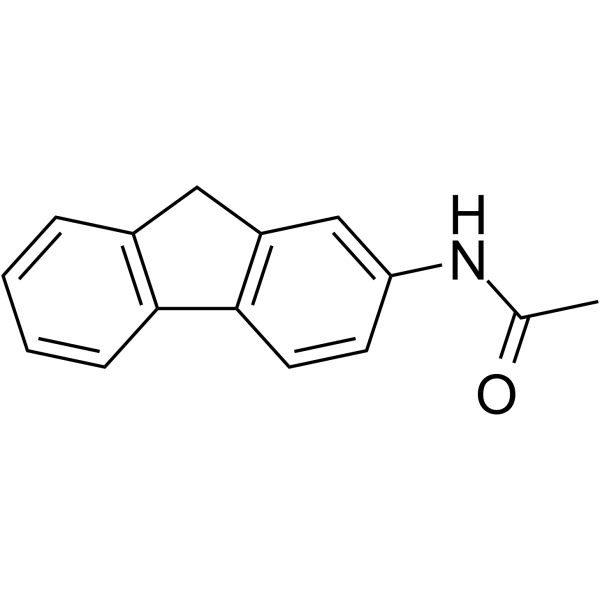 |
2-Acetamidofluorene
CAS:53-96-3 |
C15H13NO |
|
A novel toxicogenomics-based approach to categorize (non-)ge...
2015-12-01 [Arch. Toxicol. 89 , 2413-27, (2015)] |
|
Optimal dose selection of N-methyl-N-nitrosourea for the rat...
2015-07-01 [Mutat. Res. Genet. Toxicol. Environ. Mutagen. 786-788 , 129-36, (2015)] |
|
Multiple programmed cell death pathways are involved in N-me...
2015-05-01 [Graefes Arch. Clin. Exp. Ophthalmol. 253 , 721-31, (2015)] |
|
DNA damage response in neonatal and adult stromal cells comp...
2015-06-01 [Stem Cells Transl. Med. 4 , 576-89, (2015)] |
|
Breast Cancer Tissue Marked Selectively by Magnetic Nanopart...
2015-12-01 [J. Nanosci. Nanotechnol. 15 , 9591-6, (2015)] |