Journal of Physical Chemistry A: Molecules, Spectroscopy, Kinetics, Environment and General Theory 2009-02-05

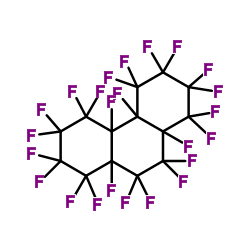
Perfluorinated polycyclic aromatic hydrocarbons: anthracene, phenanthrene, pyrene, tetracene, chrysene, and triphenylene.

Xuejun Feng, Qianshu Li, Jiande Gu, F Albert Cotton, Yaoming Xie, Henry F Schaefer

Index: J. Phys. Chem. A 113(5) , 887-94, (2009)

Full Text: HTML

Abstract

The properties of perfluoroanthracene (1-C(14)F(10)), perfluorophenanthrene (2-C(14)F(10)), perfluoropyrene (C(16)F(10)), perfluorotetracene (1-C(18)F(12)), perfluorochrysene (2-C(18)F(12)), and perfluorotriphenylene (3-C(18)F(12)) and their radical anions have been studied using density functional theory (DFT). Three measures of neutral-anion energy separations reported in this work are the adiabatic electron affinity (EA(ad)), the vertical electron affinity (EA(vert)), and the vertical detachment energy (VDE). The vibrational frequencies of these perfluoro PAHs and their radical anions are also examined. The predicted adiabatic electron affinities (DZP++ B3LYP) are: 1.84 eV, 1-C(14)F(10); 1.41 eV, 2-C(14)F(10); 1.72 eV, C(16)F(10); 2.39 eV, 1-C(18)F(12); 1.83 eV (C(i) symmetry) and 1.88 eV (C(2) symmetry), 2-C(18)F(12); and 1.69 eV, 3-C(18)F(12). The perfluorotetracene is clearly the most effective electron captor. Perfluorophenanthrene, perfluoropyrene, perfluorochrysene, and perfluorotriphenylene, as well as their radical anions deviate from planarity. For example, the nonplanar perfluorochrysene structures are predicted to lie 7-13 kcal/mol below the pertinent C(2h) stationary points.

Related Compounds

Structure Name/CAS No. Articles
Chrysene Structure Chrysene
CAS:218-01-9
flutec pp11 Structure flutec pp11
CAS:306-91-2