Solvent and temperature effects on the conformational equilibria of a dihydrobenzo[h]quinolinium fluoroborate.
Marcos Caroli Rezende, Juan Guerrero
Index: Magn. Reson. Chem. 47(6) , 505-10, (2009)
Full Text: HTML
Abstract
Spectra of the N-phenyl-5,6-dihydro-2,4-diphenylbenzo[h]quinolinium tetrafluoroborate (1) and of the N-phenyl-5,6,8,9-tetrahydro-7-phenyldibenzo[c,h]acridinium tetrafluoroborate (2) were recorded in various solvents and temperatures. The analysis of the (1)H-NMR spectra of the tetrafluoroborate salt 1, recorded in acetone, acetonitrile, 1,1,2,2-tetrachloroethane and chloroform, revealed the existence of an equilibrium between two conformers in solution. Tight ion-pairing in chloroform led to a smaller barrier for interconversion between the two conformers. In more polar solvents, where the dihydrobenzoquinolinium exists as a free cation, theoretical calculations predicted larger barriers. The spectra of 1 in 1,1,2,2-tetrachloroethane also varied with temperature, resembling at higher temperatures the spectrum in CDCl(3) and at 300K spectra in more polar media. Spectra of 2 did not vary with the solvent or the temperature, in an indication of a much higher barrier to conformational interconversion, because of a greater steric hindrance between the N-phenyl substituent and the dihydrobenzo rings.2009 John Wiley & Sons, Ltd.
Related Compounds
| Structure | Name/CAS No. | Molecular Formula | Articles |
|---|---|---|---|
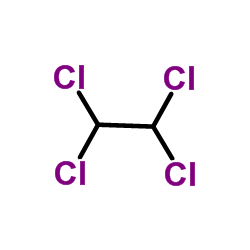 |
1,1,2,2-Tetrachloroethane
CAS:79-34-5 |
C2H2Cl4 |
|
QSPR modeling of octanol/water partition coefficient for vit...
2008-04-01 [Eur. J. Med. Chem. 43 , 714-40, (2008)] |
|
Development of QSAR models for predicting hepatocarcinogenic...
2009-09-01 [Eur. J. Med. Chem. 44 , 3658-64, (2009)] |
|
Simultaneous derivatization and solid-based disperser liquid...
2015-03-01 [J. Chromatogr. B. Analyt. Technol. Biomed. Life Sci. 983-984 , 55-61, (2015)] |
|
Development of a new extraction method based on counter curr...
2016-01-01 [Talanta 146 , 772-9, (2015)] |
|
A sensitive and efficient method for trace analysis of some ...
2015-12-01 [Biomed. Chromatogr. 29 , 1921-31, (2015)] |