Human accidents involving Rhinocricus spp., a common millipede genus observed in urban areas of Brazil.
Eduardo Mello De Capitani, Ronan José Vieira, Fábio Bucaretchi, Luciane C R Fernandes, Adriana Safioti Toledo, Adriana C Camargo
Index: Clin. Toxicol. (Phila.) 49(3) , 187-90, (2011)
Full Text: HTML
Abstract
The most important millipede species causing accidents in Brazil is Rhinocricus padbergi (order Spirobolida, family Rhinocricidae), a vegetarian scavenger distributed from Central to South America. Eleven clinical cases of dermal and oral accidental exposures to secretions from Rhinocricus spp. milipedes are described.Eleven cases of skin and oral involvement after accidental contact with the secretions of Rhinocricus spp. in patients from 1to 46 years are detailed. Ten of the 11 accidents involved the feet and in 1 child the mouth. Mild pain was reported in two of the cases, and a transient local burning sensation was described by most of the patients. Three reported no pain or any sensation at all. What was observed in all patients was a dark reddish or blackish staining of the skin simulating inflammatory or even necrotic lesions, which resolved naturally after some weeks.Despite the necrotic appearance of Rhinocricus spp. skin lesions, only a very mild inflammation and no necrosis occur. Analysis of the content of 50 glands of these animals captured in the southeast region of Brazil identified 2-methil-1,4-benzoquinone and 3,3a,4,5-tetrahydro-1H-pyrrolo-[2,3-b] pyridine-2,6-dione as the substances responsible for the lesions. Benzoquinones are strongly irritant and persistent compounds, working very well as insect repellents and are toxic to a great variety of other parasites and pathogens. They also have tanning properties. No systemic toxic effects have been described so far after skin contact with benzoquinones or Rhinocricus species.
Related Compounds
| Structure | Name/CAS No. | Molecular Formula | Articles |
|---|---|---|---|
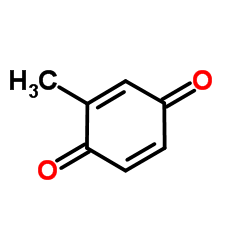 |
2-Methylcyclohexa-2,5-diene-1,4-dione
CAS:553-97-9 |
C7H6O2 |
|
Indoleamine 2,3-dioxygenase is the anticancer target for a n...
2008-03-27 [J. Med. Chem. 51 , 1706-18, (2008)] |
|
A class of benzenoid chemicals suppresses apoptosis in C. el...
2006-12-01 [ChemBioChem. 7(12) , 2010-5, (2006)] |
|
Oxidative DNA damage by minor metabolites of toluene may lea...
1999-08-02 [Biochem. Biophys. Res. Commun. 261(2) , 478-83, (1999)] |
|
Isolation and characterizations of quinone analogue-resistan...
1998-09-15 [Biochemistry 37(37) , 12744-52, (1998)] |
|
Odoriferous Defensive stink gland transcriptome to identify ...
2013-01-01 [PLoS Genet. 9(7) , e1003596, (2013)] |