Antiamoebic coumarins from the root bark ofAdina cordifoliaand their new thiosemicarbazone derivatives
Prince Firdoos Iqbal, Abdul Roouf Bhat, Amir Azam, Prince Firdoos Iqbal, Abdul Roouf Bhat, Amir Azam, Prince Firdoos Iqbal, Abdul Roouf Bhat, Amir Azam
Index: J. Chromatogr. B. Analyt. Technol. Biomed. Life Sci. 878(30) , 3052-8, (2010)
Full Text: HTML
Abstract
In continuation of our search for potential antiamoebic agents from folklore Indian medicinal plants, we found that the benzene and ethyl acetate extracts from the root bark of Adina cordifolia exhibited strong antiamoebic activity with IC 50 values of 2.92 and 2.50 μg/ml, respectively. Bioassay-guided fractionation of benzene and ethyl acetate extracts led to the isolation of 7-hydroxycoumarin (umbelliferone 1) and 7-β-D-glucosylcoumarin (skimmin 2), respectively. Umbelliferone 1 was converted into 7-acetoxycoumarin 1a, which on treatment with aluminium chloride afforded 7-hydroxy-8-acetylcoumarin 2a. A new series of thiosemicarbazones 3a– e of 7-hydroxy-8-acetylcoumarin with different thiosemicarbazides were synthesized. Umbelliferone was also converted into its methoxy derivative (7-methoxycoumarin 4). Subsequently, all the compounds were assessed for antiamoebic activity against HM1:IMMS strain of Entamoeba histolytica. Umbelliferone and skimmin were found to possess a very good activity with IC 50 values of 6.38 and 4.35 μM/ml, respectively. The activity drastically increased on converting compound 2a into its thiosemicarbazone derivatives 3a– e with IC 50 values ranging between 1.06 and 4.46 μM/ml. Compounds 3b, c and e with IC 50 values of 1.49, 1.56 and 1.06 μM/ml, respectively, exhibited even higher antiamoebic activity than the standard drug metronidazole (IC 50 = 2.62 μg/ml). The activity of 7-methoxycoumarin (IC 50 = 8.92 μM/ml) was less than umbelliferone. Compounds 3b, c and e were tested for toxicity using H9c2 cardiac myoblasts cell line. The compounds exhibit >80% viability at 3.125–200 μg/ml. It is apparent from these results that umbelliferone and skimmin may be a useful lead for the development of new antiamoebic drugs.
Related Compounds
| Structure | Name/CAS No. | Molecular Formula | Articles |
|---|---|---|---|
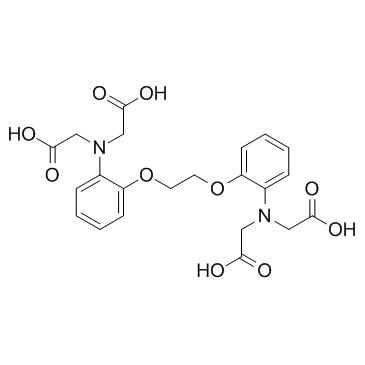 |
BAPTA
CAS:85233-19-8 |
C22H24N2O10 |
|
The Ca²⁺-calmodulin-Ca²⁺/calmodulin-dependent protein kinase...
2014-09-01 [Arch. Toxicol. 88(9) , 1695-709, (2014)] |
|
Activation of epidermal growth factor receptor is required f...
2014-01-01 [BMC Microbiol. 14 , 277, (2015)] |
|
HD iPSC-derived neural progenitors accumulate in culture and...
2015-06-01 [Hum. Mol. Genet. 24 , 3257-71, (2015)] |
|
The endogenous caspase-8 inhibitor c-FLIPL regulates ER morp...
2015-07-01 [Cell Death Differ. 22 , 1131-43, (2015)] |
|
Cation binding site of cytochrome c oxidase: progress report...
2014-07-01 [Biochim. Biophys. Acta 1837(7) , 1188-95, (2014)] |