Pharmacokinetics of a valpromide isomer, valnoctamide, in healthy subjects.
M Bialer, A Haj-Yehia, N Barzaghi, F Pisani, E Perucca
Index: Eur. J. Clin. Pharmacol. 38(3) , 289-91, (1990)
Full Text: HTML
Abstract
The pharmacokinetics of a single 400 mg oral dose of valnoctamide (VCD) has been investigated in seven healthy, adult, male volunteers. VCD was not biotransformed rapidly to its corresponding acid valnoctic acid (VCA), unlike its isomer valpromide (VPD). It had a mean residence time of 13.2 h and a terminal half-life of 9.3 h. Throughout the study, only low plasma levels of VCA could be detected. Thus, unlike VPD, which is a pro-drug of the corresponding acid, (valproic acid, VPA). VCD appears to act as a drug in its own right, and it does not undergo similar hydrolysis. The pharmacokinetic difference may account for the different pharmacological activities of the two isomers.
Related Compounds
| Structure | Name/CAS No. | Molecular Formula | Articles |
|---|---|---|---|
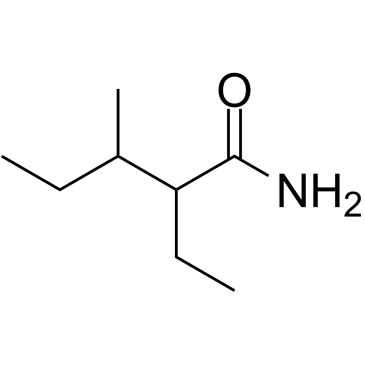 |
Valnoctamide
CAS:4171-13-5 |
C8H17NO |
|
Structure activity relationship of human microsomal epoxide ...
2000-02-01 [Pharm. Res. 17(2) , 216-21, (2000)] |
|
A comparative electrographic analysis of the effect of sec-b...
2013-02-12 [Neuroscience 231 , 145-56, (2013)] |
|
Amidic modification of valproic acid reduces skeletal terato...
2004-02-01 [Birth Defects Res. B Dev. Reprod. Toxicol. 71(1) , 47-53, (2004)] |
|
Polycomb homologs are involved in teratogenicity of valproic...
2004-11-01 [Birth Defects Res. A Clin. Mol. Teratol. 70(11) , 870-9, (2004)] |
|
Identification of early-responsive genes correlated to valpr...
2005-04-01 [Birth Defects Res. A Clin. Mol. Teratol. 73(4) , 229-38, (2005)] |