733750-99-7
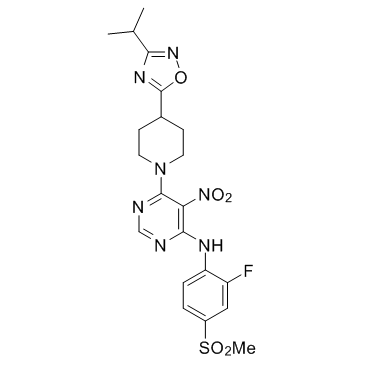
733750-99-7 structure
- Name: AR 231453
- Chemical Name: N-(2-fluoro-4-methylsulfonylphenyl)-5-nitro-6-[4-(3-propan-2-yl-1,2,4-oxadiazol-5-yl)piperidin-1-yl]pyrimidin-4-amine
- CAS Number: 733750-99-7
- Molecular Formula: C21H24FN7O5S
- Molecular Weight: 505.52300
- Catalog: Signaling Pathways GPCR/G Protein GPR119
- Create Date: 2019-01-01 11:06:36
- Modify Date: 2026-10-01 07:54:54
-
AR231453 is a potent and selective small molecule agonist of GPR119 that enhances glucose-dependent insulin secretion and glucagon-like peptide 1 (GLP-1) release; Antidiabetic agent.IC50 value: Target: GPR119in vitro: The GPR119-specific agonist AR231453 significantly increased cAMP accumulation and insulin release in both HIT-T15 cells and rodent islets. In both cases, loss of GPR119 rendered AR231453 inactive [1]. In GLUTag cells, a well-established model of intestinal L-cell function, the potent GPR119 agonist AR231453 stimulated cAMP accumulation and GLP-1 release [2].in vivo: AR231453 also enhanced glucose-dependent insulin release in vivo and improved oral glucose tolerance in wild-type mice but not in GPR119-deficient mice. Diabetic KK/A(y) mice were also highly responsive to AR231453. Orally active GPR119 agonists may offer significant promise as novel antihyperglycemic agents acting in a glucose-dependent fashion [1]. When administered in mice, AR231453 increased active GLP-1 levels within 2 min after oral glucose delivery and substantially enhanced total glucose-dependent insulinotropic peptide levels. Blockade of GLP-1 receptor signaling with exendin(9-39) reduced the ability of AR231453 to improve glucose tolerance in mice [2].
| Name | N-(2-fluoro-4-methylsulfonylphenyl)-5-nitro-6-[4-(3-propan-2-yl-1,2,4-oxadiazol-5-yl)piperidin-1-yl]pyrimidin-4-amine |
|---|---|
| Synonyms |
4-Pyrimidinamine, N-[2-fluoro-4-(methylsulfonyl)phenyl]-6-[4-[3-(1-methylethyl)-1,2,4-oxadiazol-5-yl]-1-piperidinyl]-5-nitro
231453; -231453 N-(2-Fluoro-4-(methylsulfonyl)phenyl)-6-(4-(3-isopropyl-1,2,4-oxadiazol-5-yl)piperidin-1-yl)-5 231453, GPR119 agonist inhibit,GPR119,-231453,G Protein-Coupled Rector 119,diabetes,231453, 231453,insulin,Inhibitor,HIT-,glucose,GPCR N-(2-Fluoro-4-(methylsulfonyl)phenyl)-6-(4-(3-isopropyl-1,2,4-oxadiazol-5-yl)piperidin-1-yl)-5-nitropyrimidin-4-amine (2-FLUORO-4-METHANESULFONYL-PHENYL)-(6-[4-(3-ISOPROPYL-[1,2,4]OXADIAZOL-5-YL)-PIPERIDIN-1-YL]-5-NITRO-PYRIMIDIN-4-YL)-AMINE N-(2-Fluoro-4-(methylsulfonyl)phenyl)-6-(4-(3-isopropyl-1,2,4-oxadiazol-5-yl)piperidin-1-yl)-5-ni 231453, 10 mM in DMSO unii-07z1p4981i |
| Description | AR231453 is a potent and selective small molecule agonist of GPR119 that enhances glucose-dependent insulin secretion and glucagon-like peptide 1 (GLP-1) release; Antidiabetic agent.IC50 value: Target: GPR119in vitro: The GPR119-specific agonist AR231453 significantly increased cAMP accumulation and insulin release in both HIT-T15 cells and rodent islets. In both cases, loss of GPR119 rendered AR231453 inactive [1]. In GLUTag cells, a well-established model of intestinal L-cell function, the potent GPR119 agonist AR231453 stimulated cAMP accumulation and GLP-1 release [2].in vivo: AR231453 also enhanced glucose-dependent insulin release in vivo and improved oral glucose tolerance in wild-type mice but not in GPR119-deficient mice. Diabetic KK/A(y) mice were also highly responsive to AR231453. Orally active GPR119 agonists may offer significant promise as novel antihyperglycemic agents acting in a glucose-dependent fashion [1]. When administered in mice, AR231453 increased active GLP-1 levels within 2 min after oral glucose delivery and substantially enhanced total glucose-dependent insulinotropic peptide levels. Blockade of GLP-1 receptor signaling with exendin(9-39) reduced the ability of AR231453 to improve glucose tolerance in mice [2]. |
|---|---|
| Related Catalog | |
| References |
| Molecular Formula | C21H24FN7O5S |
|---|---|
| Molecular Weight | 505.52300 |
| Exact Mass | 505.15400 |
| PSA | 168.31000 |
| LogP | 5.30340 |
| Storage condition | 2-8℃ |
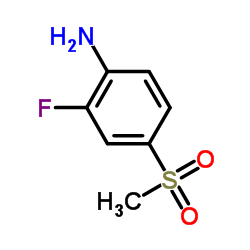
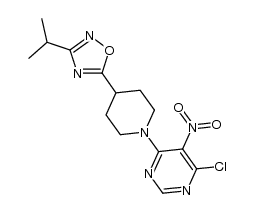
| Precursor 2 | |
|---|---|
| DownStream 0 | |