- Shanghai Nianxing Industrial Co., Ltd
- China
- Product Name: Palmitic acid
- Price: Check
- Purity: 98.0%
- Stocking Period: 10 Day
- Contact: Yang
- Email: sales@echemcloud.com
- Dayang Chem (Hangzhou) Co., Ltd.
- China
- Product Name: tris-(2-Carboxyethyl)phosphine hydrochloride
- Price: $Inquiry/100g $Inquiry/1kg $Inquiry/100kg $Inquiry/1000kg
- Purity: 98.0%
- Stocking Period: Inquiry
- Contact: Ms Wang
- Email: enquiry@dycnchem.com
- Henan Tianfu Chemical Co., Ltd.
- China
- Product Name: TRIS(2-CARBOXYETHYL)PHOSPHINE HYDROCHLORIDE
- Price: $Inquiry/1kg $Inquiry/25kg $Inquiry/1000kg $Inquiry/10ton
- Purity: 99.0%
- Stocking Period: Inquiry
- Contact: Anson
- Email: info@tianfuchem.com
- Zhongshan Xingrui Chemical Co. , Ltd.
- China
- Product Name: Tris(2-carboxyethyl)phosphine Hydrochloride
- Price: ¥Inquiry/25kg
- Purity: 99.0%
- Stocking Period: Inquiry
- Contact: Wang Jie

- Email: 3096638339@qq.com
51805-45-9
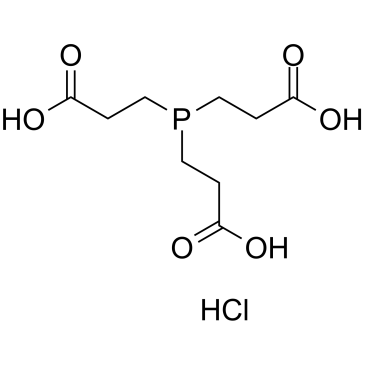
51805-45-9 structure
- Name: Tris(2-carboxyethyl)phosphine Hydrochloride
- Chemical Name: tris(2-carboxyethyl)phosphine hydrochloride
- CAS Number: 51805-45-9
- Molecular Formula: C9H16ClO6P
- Molecular Weight: 286.647
- Catalog: Organic raw materials Organic phosphine compound
- Create Date: 2018-05-08 08:00:00
- Modify Date: 2026-06-30 12:25:34
-
TCEP hydrochloride (Tris(2-carboxyethyl)phosphine hydrochloride) is a non-thiol reducing agent that is more stable and produces a faster S-S reductive reaction than other chemical reductants. TCEP hydrochloride is a trialkylphosphine, selectively reduces protein disuldes without altering the properties or interacting with thiol-directed agents in the reaction mixture. TCEP hydrochloride is also a commonly used reducing agent in the DNA/AuNP chemistry[1][2][3][4].
| Name | tris(2-carboxyethyl)phosphine hydrochloride |
|---|---|
| Synonyms |
3,3',3''-phosphinetriyltripropanoic acid hydrochloride
Tris(2-cboxyethyl) Phosphine Hydrochloride (TC extrapure TCHydrochloride (0.5M in water) Propanoic acid,3,3',3''-phosphinylidynetris-, hydrochloride (1:1) 3,3',3''-Phosphinetriyltripropanoic acid hydrochloride 500 MM TC TC.HCLTris(2-Cboxyethyl)Phosphine Hydrochloride Propanoic acid, 3,3',3''-phosphinidynetris-, hydrochloride (1:1) TRIS(CBOXYETHYL)PHOSPHINE HYDROCHLORIDE Tris(2-cboxyethyl)phosphine hydrochloride Tris(2-cboxyethyl)phosphine hydrochloride (TCHCl salt) TC, HYDROCHLORIDE Tris(2-cboxyethyl)phosphine hydrochloride powder, >= TC, Hydrochloride salt Protein And Ptide Recombination 0.5M TC Tris (2-cbonylethyl) phosphate hydrochloride TRIS-(2-CBOXYETHYL)PHOSPHINE HYDROCHLORIDE (TCHCL) TRIS(2-CYANOETHYL)PHOSPHINE,TC.HCL) TRIS(CBOXYETHYL)PHOSPHINE & MFCD00145469 TC*HCL Tris(2-cboxyethyl)phosphine-D16DCl Tris(2-cboxyethyl)phosphine hydrochloride 0.5M soln. in water Tris 2-cboxyethyl phospene DCL (TC D16 3-bis(2-Cboxyethyl)phosphanylpropanoic acid hydrochloride (0.5M solution in water) Tris(cboxyethyl)phosphine.HC Tris(2-cboxyethyl)phosphine,hydrochloride Protein And Ptide Recombination (Tc·Hcl) TCSolution Tris(cboxyethyl)phosphine HCl 3,3',3''-Phosphinidynetrispropanoic Acid Hydrochloride TC-HCl, OMniPur(R) 3-[bis(2-carboxyethyl)phosphanyl]propanoic acid,hydrochloride TRIS-(2-CBOXYETHYL)PHOSPHINE HYDROCHLORIDE (TC TC-HCI TRIS(2-CBOXYETHYL)PHOSPHINE HYDROC Tris(2-cboxyethyl)phosphine solution hydrochloride Tri (2-cbonylethyl) phosphine hydrochloride )phosphine hydrochL TC.HCL Tris(2-Cboxyethyl)Phosphine Hydrochloride TRIS(2-CBOXYETHYL)PHOSPHINE, HCL Tris(2-cboxyethyl)phosphonium Hydrochloride 3,3',3''-PHOSPHINIDYNE-TRIPROPIONIC ACID HYDROCHLORIDE TC, Hydrochloride, ade Tris(2-cboxyethyl)phosphine hydrochloride, 0.5M soln in water TCHCL Tris(2-cboxyethyl)phosphine hydrochloride solution Three(2- Suo Yiji)phosphine hydrochloride Tris(2-cboxyethyl)phosphine, hydrochloride, TC Tris(2-cboxyethyl)phosphine hydrochloride solution,TC TRIS(2-CBOXYETHYL)PHOSPHINE:DCL (TC Tris-(2-cboxyethy)phosphine hydrochloride Tris(2-cboxyethyl)phosphine hydrochlo 3,3',3''-Phosphinetriyltripropanoic acid hydrochloride (1:1) Tri (2-cbonylethyl) phosphate hydrochloride Tris(2-cboxyethyl)phosphine hydrochloride, R TRI(2-CBOXYETHYL)PHOSPHINE HYDROCHLORIDE Ris(2-Cboxyethyl)Phosphinehydrochloride |
| Description | TCEP hydrochloride (Tris(2-carboxyethyl)phosphine hydrochloride) is a non-thiol reducing agent that is more stable and produces a faster S-S reductive reaction than other chemical reductants. TCEP hydrochloride is a trialkylphosphine, selectively reduces protein disuldes without altering the properties or interacting with thiol-directed agents in the reaction mixture. TCEP hydrochloride is also a commonly used reducing agent in the DNA/AuNP chemistry[1][2][3][4]. |
|---|---|
| Related Catalog | |
| In Vitro | TCEP hydrochloride has been introduced which oers the prospect of serving as an alternative to the more commonly employed DTT in the NF-κB-DNA binding reactions in vitro, using recombinant p50 protein and a 32P-labelled κB oligonucleotide. DTT promotes NF-κB-DNA binding in concentrations from 0.25 to 2.6 mM in binding reactions. However, in the presence of 0.25 mM DTT, inhibition of NF-κB binding is seen only at Hg2+ concentrations greater than 100 μM and results are highly variable. In contrast, TCEP hydrochloride promotes NF-κB-DNA binding in a dose-related manner in concentrations from 0.25 to 6 mM. In the presence of even 6 mM TCEP hydrochloride, Hg2+ prevents NF-κB-DNA binding at concentrations as low as 20 μM in binding reactions[1]. The human lactoferrin (hLF) peptide is dissolved in phosphate buffer to a concentration of 0.1 mm. Reduction of the disulfide bonds is obtained by adding a 30-fold molar excess of TCEP hydrochloride with subsequent incubation for 2 h at 37 ℃[2]. |
| References |
| Density | 1.041 g/mL at 25 °C |
|---|---|
| Boiling Point | 519.4ºC at 760 mmHg |
| Melting Point | 177 °C |
| Molecular Formula | C9H16ClO6P |
| Molecular Weight | 286.647 |
| Flash Point | 267.9ºC |
| Exact Mass | 286.037292 |
| PSA | 125.49000 |
| LogP | 1.69440 |
| Appearance | powder | white |
| Index of Refraction | n20/D 1.367 |
| Storage condition | 2-8°C |
| Water Solubility | H2O: 50 mg/mL |
| Symbol |

GHS05 |
|---|---|
| Signal Word | Danger |
| Hazard Statements | H314 |
| Precautionary Statements | P280-P305 + P351 + P338-P310 |
| Personal Protective Equipment | Eyeshields;Faceshields;full-face particle respirator type N100 (US);Gloves;respirator cartridge type N100 (US);type P1 (EN143) respirator filter;type P3 (EN 143) respirator cartridges |
| Hazard Codes | Xi:Irritant; |
| Risk Phrases | R36/37/38 |
| Safety Phrases | S26-S37/39-S36/37/39-S27 |
| RIDADR | UN 3261 8/PG 2 |
| WGK Germany | 2 |
| Packaging Group | III |
| Hazard Class | 8.0 |
| HS Code | 2915900090 |
| HS Code | 2915900090 |
|---|---|
| Summary | 2915900090 other saturated acyclic monocarboxylic acids and their anhydrides, halides, peroxides and peroxyacids; their halogenated, sulphonated, nitrated or nitrosated derivatives VAT:17.0% Tax rebate rate:9.0% Supervision conditions:AB(certificate of inspection for goods inward,certificate of inspection for goods outward) MFN tariff:5.5% General tariff:30.0% |