338747-41-4
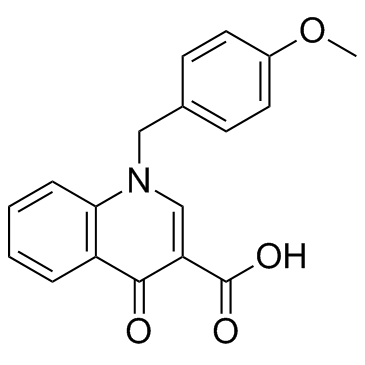
338747-41-4 structure
- Name: BQCA
- Chemical Name: 1-[(4-methoxyphenyl)methyl]-4-oxoquinoline-3-carboxylic acid
- CAS Number: 338747-41-4
- Molecular Formula: C18H15NO4
- Molecular Weight: 309.316
- Catalog: Signaling Pathways GPCR/G Protein mAChR
- Create Date: 2018-12-29 20:37:33
- Modify Date: 2026-07-02 12:50:42
-
BQCA a highly selective allosteric modulator of the M1 mAChR.
| Name | 1-[(4-methoxyphenyl)methyl]-4-oxoquinoline-3-carboxylic acid |
|---|---|
| Synonyms |
1-(4-Methoxybenzyl)-4-oxo-1,4-dihydroquinoline-3-cboxylic acid
BQCA, 10 mM in DMSO bqca mAChR,Muscinic acetylcholine rector,Inhibitor,inhibit,BQCA 1-(4-Methoxybenzyl)-4-oxo-1,4-dihydro-3-quinolinecarboxylic acid 1-(4-Methoxybenzyl)-4-oxo-1,4-dihydro-3-quinolinecboxylic 3-Quinolinecboxylic acid, 1,4-dihydro-1-[(4-methoxyphenyl)methyl]-4-oxo Benzyl quinolone cboxylic acid 1-(4-METHOXYBENZYL)-4-OXO-1,4-DIHYDRO-3-QUINOLINECBOXYLIC ACID |
| Description | BQCA a highly selective allosteric modulator of the M1 mAChR. |
|---|---|
| Related Catalog | |
| In Vitro | BQCA reduces the concentration of ACh required to activate M1 up to 129-fold with an inflection point value of 845 nM. No potentiation, agonism, or antagonism activity on other mAChRs is observed up to 100 μM[1]. BQCA increases M1 receptor affinity for acetylcholine. The activation of the M1 receptor by BQCA induces a robust inward current and increases spontaneous excitatory postsynaptic currents in medial prefrontal cortex (mPFC) pyramidal cells[2]. |
| In Vivo | BQCA requires M1 to promote inositol phosphate turnover in primary neurons and to increase c-fos and arc RNA expression and ERK phosphorylation in the brain. BQCA reverses scopolamine-induced memory deficits in contextual fear conditioning, increases blood flow to the cerebral cortex, and increases wakefulness while reducing delta sleep. BQCA induces β-arrestin recruitment to M1, suggesting a role for this signal transduction mechanism in the cholinergic modulation of memory[1]. BQCA increases firing of mPFC pyramidal cells in vivo. BQCA also restores discrimination reversal learning in a transgenic mouse model of Alzheimer's disease[2]. |
| Kinase Assay | Competition binding reactions used 25 μg human M1 CHO membrane protein, BQCA or vehicle, and 0.15 nM [3H]NMS in 96-well deep-well plates. Binding reactions (30 °C for 2-3 h) are terminated by rapid filtration. Nonspecific binding is determined by adding 10 μM atropine. Filter plates are ished 4×with ice-cold 20 mM HEPES, 100 mM NaCl, and 5 mM MgCl2, pH 7.4 using a 96-well harvester. Plates are dried and radioactivity counted with a microplate scintillation counter[1]. |
| Animal Admin | Rats: Male Sprague-Dawley rats weighing 225-250 g, are injected i.p. with the micro-suspension (containing 10% tween 80) of BQCA at the dose of 10 mg/kg. The blood and whole brain tissue samples are collected at 0.5, 1, 2, 4 and 8 h. Blood samples are collected through cardiac puncture in EDTA vacutainer tubes. The plasma is separated by centrifugation and stored at −80°C until analysis. The animals are decapitated and the whole brain tissue are removed and immediately frozen on dry ice[2]. Mice: Mice are dosed I.P. with BQCA in 5% beta-cyclodextrin and/or 0.3 mg/kg scopolamine in 0.9% saline 30 min before placement into a chamber for 2 min before 2 tone-footshock pairings (3 kHz, 85 dB tone for 30 s co-terminated with a 0.5 mA, 1 s shock) 2 min apart. Mice are removed to their home cage 30 s after the last pairing. Twenty-four hours later mice are placed into the same chamber and freezing is measured by Video Freeze[1]. |
| References |
| Density | 1.3±0.1 g/cm3 |
|---|---|
| Boiling Point | 492.6±45.0 °C at 760 mmHg |
| Molecular Formula | C18H15NO4 |
| Molecular Weight | 309.316 |
| Flash Point | 251.7±28.7 °C |
| Exact Mass | 309.100098 |
| PSA | 68.53000 |
| LogP | 2.83 |
| Vapour Pressure | 0.0±1.3 mmHg at 25°C |
| Index of Refraction | 1.649 |
| Storage condition | 2-8℃ |
| Symbol |

GHS07 |
|---|---|
| Signal Word | Warning |
| Hazard Statements | H302 |
| RIDADR | NONH for all modes of transport |
| HS Code | 2933499090 |
| HS Code | 2933499090 |
|---|---|
| Summary | 2933499090. other compounds containing in the structure a quinoline or isoquinoline ring-system (whether or not hydrogenated), not further fused. VAT:17.0%. Tax rebate rate:13.0%. . MFN tariff:6.5%. General tariff:20.0% |