- Shanghai Nianxing Industrial Co., Ltd
- China
- Product Name: Palmitic acid
- Price: Check
- Purity: 98.0%
- Stocking Period: 10 Day
- Contact: Yang
- Email: sales@echemcloud.com
- Dayang Chem (Hangzhou) Co., Ltd.
- China
- Product Name: Hydroxypropyl cellulose
- Price: $Inquiry/100g $Inquiry/1kg $Inquiry/100kg $Inquiry/1000kg
- Purity: 98.0%
- Stocking Period: Inquiry
- Contact: Ms Wang
- Email: enquiry@dycnchem.com
- Henan Tianfu Chemical Co., Ltd.
- China
- Product Name: TIANFU-CHEM Hydroxypropyl cellulose
- Price: $Inquiry/1kg $Inquiry/25kg $Inquiry/1000kg $Inquiry/10ton
- Purity: 99.0%
- Stocking Period: Inquiry
- Contact: Anson
- Email: info@tianfuchem.com
- Zhongshan Xingrui Chemical Co. , Ltd.
- China
- Product Name: Hydroxypropyl Cellulose
- Price: ¥Inquiry/1kg ¥Inquiry/25kg ¥Inquiry/200kg
- Purity: 99.0%
- Stocking Period: 3 Day
- Contact: Wang Jie

- Email: 3096638339@qq.com
9004-64-2
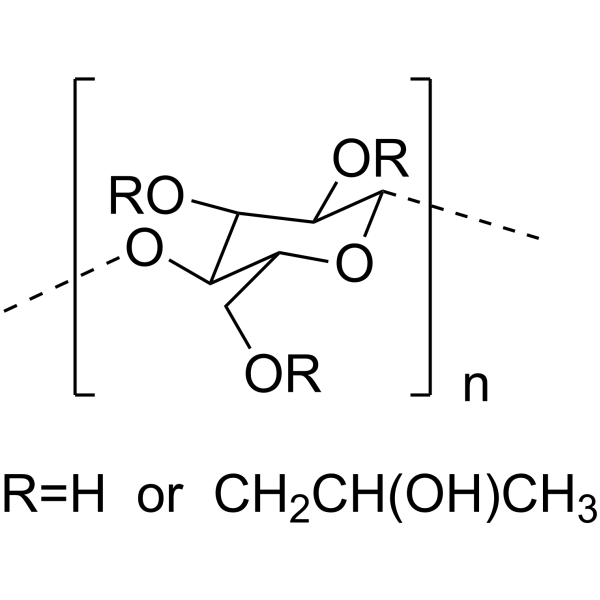
9004-64-2 structure
- Name: Hydroxypropyl Cellulose
- Chemical Name: Hydroxypropyl cellulose
- CAS Number: 9004-64-2
- Molecular Formula: C36H70O19
- Molecular Weight: 806.930
- Catalog: Biochemical Carbohydrate Polysaccharide
- Create Date: 2018-07-29 10:15:19
- Modify Date: 2026-07-02 00:22:14
-
Hydroxypropyl Cellulose is somewhat amphiphilic in character and is a surfactant. Hydroxypropyl Cellulose can be used as a pharmaceutical excipient, such as coating agent, emulsifier, suspension, tablet, thickener, viscosifier. Pharmaceutical excipients, or pharmaceutical auxiliaries, refer to other chemical substances used in the pharmaceutical process other than pharmaceutical ingredients. Pharmaceutical excipients generally refer to inactive ingredients in pharmaceutical preparations, which can improve the stability, solubility and processability of pharmaceutical preparations. Pharmaceutical excipients also affect the absorption, distribution, metabolism, and elimination (ADME) processes of co-administered drugs[1][2].
| Name | Hydroxypropyl cellulose |
|---|---|
| Synonyms |
KLUCEL
hydroxypropyl Hydroxypropyl cellulose - - 1250,000 (HYDROXYPROPYL)CELLULOSE STANDD 30'000 2-Hydroxypropyl cellulose H-HPC (J type) Hydroxypropyl cellulose, Average (HYDROXYPROPYL)CELLULOSE STANDD 25'000 Hydroxypropyl Cellulose (1,000mPa.s, in Water at 20°C) Klucel HYDROXYPROPYL CELLULOSE Hydroxypropyl cellulose , average powder, 20 Mesh pticle size ( through) HYDROXYPROPYL CELLULOSE, AVERAGE MW. CA. 80,000 Hydroxypropyl cellulose , powder, 20 mesh pticle size ( through) HPC, hydroxypropyl cellulose Low-Substitute Hydropropyl Cellulose (HYDROXYPROPYL)CELLULOSE STANDD 50'000 H-HPC (M type) (HYDROXYPROPYL)CELLULOSE STANDD 20'000 L-Hydroxypropylcellulose Low-Substituted Hydroxypropyl cellulose MFCD00132688 HYDROXYPROPYL CELLULOSE, 10 MPAS (HYDROXYPROPYL)CELLULOSE STANDD 15'000 low substituted hydroxypropyl cellulose(LH21) Hydroxypropyl cellulose, Average M.W. 100.000R HYDROXYPROPYL CELLULOSE, MPAS Hydroxypropyl Cellulose (mPa.s, in Water at 20°C) oxypropylatedcellulose syntheticvegetablegums pm50 HYDROXYPROPYL CELLULOSE LOW-SUBSTITUTED HYDROXYPROPYLCELLULOSE (HYDROXYPROPYL)CELLULOSE STANDD 10'000 pm50(polymer) CELLULOSE, 2-HYDROXYPROPYL ETHER cellulosehydroxypropylether 2-Hydroxypropyl 2,3,6-tris-O-(2-hydroxypropyl)-4-O-[2,3,4,6-tetrakis-O-(2-hydroxypropyl)-α-D-glucopyranosyl]-β-D-glucopyranoside (HYDROXYPROPYL)CELLULOSE STANDD 35'000 L-HPC hydroxypropyletherofcellulose |
| Description | Hydroxypropyl Cellulose is somewhat amphiphilic in character and is a surfactant. Hydroxypropyl Cellulose can be used as a pharmaceutical excipient, such as coating agent, emulsifier, suspension, tablet, thickener, viscosifier. Pharmaceutical excipients, or pharmaceutical auxiliaries, refer to other chemical substances used in the pharmaceutical process other than pharmaceutical ingredients. Pharmaceutical excipients generally refer to inactive ingredients in pharmaceutical preparations, which can improve the stability, solubility and processability of pharmaceutical preparations. Pharmaceutical excipients also affect the absorption, distribution, metabolism, and elimination (ADME) processes of co-administered drugs[1][2]. |
|---|---|
| Related Catalog | |
| References |
| Density | 1.3±0.1 g/cm3 |
|---|---|
| Boiling Point | 891.2±65.0 °C at 760 mmHg |
| Molecular Formula | C36H70O19 |
| Molecular Weight | 806.930 |
| Flash Point | 492.8±34.3 °C |
| Exact Mass | 806.451111 |
| LogP | -1.24 |
| Appearance | powder | White to light cream |
| Vapour Pressure | 0.0±0.6 mmHg at 25°C |
| Index of Refraction | 1.532 |
| Stability | Stable. Incompatible with strong oxidizing agents. Combustible. |
| Water Solubility | polar oganic solvents: soluble |
| Personal Protective Equipment | Eyeshields;Gloves;type N95 (US);type P1 (EN143) respirator filter |
|---|---|
| Hazard Codes | S24/S25 |
| Safety Phrases | 24/25 |
| RIDADR | NONH for all modes of transport |
| WGK Germany | 1 |
| RTECS | NF9050000 |