261521-21-5
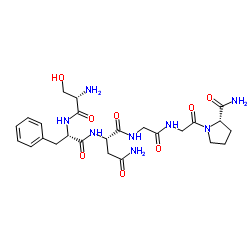
261521-21-5 structure
- Name: PAR-3 (1-6) amide (mouse) trifluoroacetate salt
- Chemical Name: L-Seryl-L-phenylalanyl-L-asparaginylglycylglycyl-L-prolinamide
- CAS Number: 261521-21-5
- Molecular Formula: C25H36N8O8
- Molecular Weight: 576.60
- Catalog: Signaling Pathways GPCR/G Protein Protease-Activated Receptor (PAR)
- Create Date: 2018-07-14 03:23:08
- Modify Date: 2026-08-23 18:14:43
-
SFNGGP-NH2 is a biological active peptide. (PAR-3 is a high-affinity thrombin receptor. PAR-3 mRNA is expressed in the cutaneous mast cells of humans. Protease-Activated Receptors (PARs) have been studied for their roles in itch and their itch-associated response through histamine-dependent/independent pathways have been reported. PAR-3 has been shown not to induce itching alone but possibly in conjunction with PAR-4. Co-expression of PAR-3 and PAR-4 enhances thrombin action suggesting that PAR-3 alone does not mediate transmembrane signaling but instead functions as a cofactor to activate PAR-4.)
| Name | L-Seryl-L-phenylalanyl-L-asparaginylglycylglycyl-L-prolinamide |
|---|---|
| Synonyms |
THROMBIN RECTOR-LIKE 2 AMIDE (MOUSE)
COAGULATION FACTOR II RECTOR-LIKE 2 AMIDE (MOUSE) L-Prolinamide, L-seryl-L-phenylalanyl-L-aspaginylglycylglycyl- (9CI) L-Prolinamide,L-seryl-L-phenylalanyl-L-aspaginylglycylglycyl P-3 AMIDE (MOUSE) Proteinase Activated Rector 3 aMide (Mouse), SFNGGPaMide, ThroMbin Rector-Like 2 aMide (Mouse), Coagulation Factor II Rector-Like 2 aMide (Mouse) SFNGGP-NH2 PAR3 Tethered Ligand (Murine) / Activates PAR1 and PAR2 H-SER-PHE-ASN-GLY-GLY-PRO-NH2 SER-PHE-ASN-GLY-GLY-PRO-NH2 L-Seryl-L-phenylalanyl-L-aspaginylglycylglycyl-L-prolinamide Protease Activated Rector-3 amide, mouse Protease-Activated Rector-3, P-3 Agonist, amide SFNGGPAMIDE SFNGGP-NH2P3TetheredLigand(Murine)/ActivatesP1 SFNGGP-NH2 P3 Tethered Ligand (Murine) / Activates P1 and P2 PROTEINASE ACTIVATED RECTOR 3 AMIDE (MOUSE) PAR-3 (1-6) amide (mouse) |
| Description | SFNGGP-NH2 is a biological active peptide. (PAR-3 is a high-affinity thrombin receptor. PAR-3 mRNA is expressed in the cutaneous mast cells of humans. Protease-Activated Receptors (PARs) have been studied for their roles in itch and their itch-associated response through histamine-dependent/independent pathways have been reported. PAR-3 has been shown not to induce itching alone but possibly in conjunction with PAR-4. Co-expression of PAR-3 and PAR-4 enhances thrombin action suggesting that PAR-3 alone does not mediate transmembrane signaling but instead functions as a cofactor to activate PAR-4.) |
|---|---|
| Related Catalog |
| Density | 1.4±0.1 g/cm3 |
|---|---|
| Boiling Point | 1229.5±65.0 °C at 760 mmHg |
| Molecular Formula | C25H36N8O8 |
| Molecular Weight | 576.60 |
| Flash Point | 697.4±34.3 °C |
| Exact Mass | 576.265625 |
| LogP | -2.38 |
| Vapour Pressure | 0.0±0.3 mmHg at 25°C |
| Index of Refraction | 1.602 |