314761-14-3
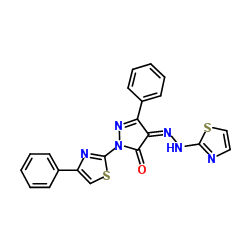
314761-14-3 structure
- Name: BTSA1
- Chemical Name: BTSA1
- CAS Number: 314761-14-3
- Molecular Formula: C21H14N6OS2
- Molecular Weight: 430.505
- Catalog: Signaling Pathways Apoptosis Apoptosis
- Create Date: 2018-04-02 15:13:22
- Modify Date: 2026-07-09 12:45:22
-
BTSA1 is a potent, high affinity and orally active BAX activator with an IC50 of 250 nM and an EC50 of 144 nM. BTSA1 binds with high affinity and specificity to the N-terminal activation site and induces conformational changes to BAX leading to BAX-mediated apoptosis[1].
| Name | BTSA1 |
|---|---|
| Synonyms | (4Z)-5-Phenyl-2-(4-phenyl-1,3-thiazol-2-yl)-4-(1,3-thiazol-2-ylhydrazono)-2,4-dihydro-3H-pyrazol-3-one |
| Description | BTSA1 is a potent, high affinity and orally active BAX activator with an IC50 of 250 nM and an EC50 of 144 nM. BTSA1 binds with high affinity and specificity to the N-terminal activation site and induces conformational changes to BAX leading to BAX-mediated apoptosis[1]. |
|---|---|
| Related Catalog | |
| Target |
Bax:250 nM (IC50) Bax:144 nM (EC50) |
| In Vitro | BTSA1 (5 μM; 6-24 hours; human AML cell lines) treatment reduced viability of all AML cell lines and displays substantial cell death activity within 6 hours[1]. BTSA1 (2.5-10 μM; 6 hours; NB4 cells) treatment induces BAX translocation coincided with the release of cytochrome c from the mitochondria to the cytosol. Significant BAX mitochondrial translocation is induced in a BTSA1 dose-dependent manner[1]. BTSA1 (0.15625-10 μM; 4-24 hours; OCI-AML3 cells) treatment induces dose-dependent caspase-3/7 activation in OCI-AML3 cells. Caspase-3/7 activation is monitored within 4-24 hours and maximal caspase-3/7 activation is detected in 4 hours[1]. Cell Viability Assaysup>[1] Cell Line: Human AML cell lines< Concentration: 5 μM Incubation Time: 6 hours, 12 hours, 24 hours Result: Reduced viability of all AML cell lines. Displayed substantial cell death activity within 6 hours. Western Blot Analysis[1] Cell Line: NB4 cells Concentration: 2.5 μM, 5 μM, 10 μM Incubation Time: 6 hours Result: Significant BAX mitochondrial translocation was induced in a dose-dependent manner. Apoptosis Analysis[1] Cell Line: OCI-AML3 cells Concentration: 0.15625 μM, 0.3125 μM, 0.625 μM, 1.25 μM, 2.5 μM, 5 μM, 10 μM Incubation Time: 4 hours, 6 hours, 8 hours, 12 hours, 24 hours Result: Induced dose-dependent caspase-3/7 activation in OCI-AML3 cells. Caspase-3/7 activation was monitored within 4-24 hr and maximal caspase-3/7 activation was detected in 4 hr. |
| In Vivo | BTSA1 (10 mg/kg; intraperitoneal injection; every two days; NOD-SCID IL2Rγ null (NSG) mice) treatment significantly increases survival when compared to vehicle-treated mice. BTSA1 treatment induces significant suppression of leukemia growth[1]. Animal Model: NOD-SCID IL2Rγ null (NSG) mice (6-8 weeks old) with THP-1 cells[1] Dosage: 10 mg/kg Administration: Intraperitoneal injection; every two days Result: Significantly increased survival when compared to vehicle-treated mice. |
| References |
| Density | 1.5±0.1 g/cm3 |
|---|---|
| Boiling Point | 625.2±48.0 °C at 760 mmHg |
| Molecular Formula | C21H14N6OS2 |
| Molecular Weight | 430.505 |
| Flash Point | 331.9±29.6 °C |
| Exact Mass | 430.067047 |
| LogP | 3.68 |
| Vapour Pressure | 0.0±1.8 mmHg at 25°C |
| Index of Refraction | 1.791 |
| Storage condition | -20℃ |