29868-97-1
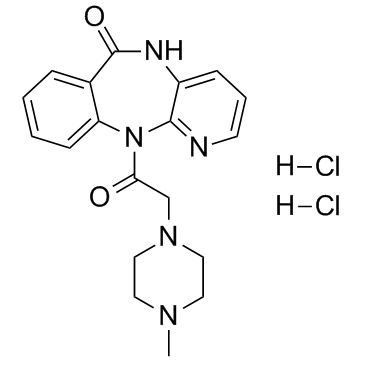
29868-97-1 structure
- Name: Pirenzepine, Dihydrochloride
- Chemical Name: Pirenzepine, Dihydrochloride
- CAS Number: 29868-97-1
- Molecular Formula: C19H23Cl2N5O2
- Molecular Weight: 424.324
- Catalog: API Digestive system medication Inhibition of gastric acid secretion
- Create Date: 2018-09-08 18:07:08
- Modify Date: 2026-06-30 19:05:27
-
Pirenzepine dihydrochloride (LS519) is a selective M1 muscarinic receptor antagonist.
| Name | Pirenzepine, Dihydrochloride |
|---|---|
| Synonyms |
Pirenzine HCL
5,11-dihydro-11-[(4-methylpiperazin-1-yl)acetyl]-6h-pyrido[2,3-b][1,4]benzodiazin-6-one dihydrochloride Pirenzine dihydrochloride, 10 mM in DMSO Gastricur Pirenzin2HCl Pirenzine dihydrochloride monohydrate CRS Maghen MFCD00055214 Pirenzepine hydrochloride Gasteril 11-[2-(4-methylpiperazin-1-yl)ethanoyl]-5H-pyrido[2,3-b][1,4]benzodiazin-6-one dihydrochloride LS 519 dihydrochloride 11-[2-(4-methylpiperazin-1-yl)acetyl]-5H-pyrido[2,3-b][1,4]benzodiazin-6-one dihydrochloride LS 519Cl2 PIRENZINE DIHYDROCHLORIDE 11-[2-(4-methyl-1-piperazinyl)-1-oxoethyl]-5H-pyrido[2,3-b][1,4]benzodiazin-6-one hydrate hydrochloride Pirenzine hydrochloride //BP pirenzing hydrochloride 6H-Pyrido[2,3-b][1,4]benzodiazin-6-one,5,11-dihydro-11-[2-(4-methyl-1-piperazinyl)acetyl]-, hydrochloride (1:2) Pirenzine dihydrochloride,5,11-Dihydro-11-[(4-methyl-1-piperazinyl)acetyl]-6H-pyrido[2,3-b][1,4]benzodiazin-6-one dihydrochloride 5,11-Dihydro-11-((4-methylpiperazin-1-yl)acetyl)-6H-pyrido(2,3-b)-(1,4)benzodiazin-6-one dihydrochloride Leblon 5,11-Dihydro-11-((4-methylpiperazin-1-yl)acetyl)-6H-pyrido(2,3-b)-(1,4)benzodiazin-6-onedihydrochloride pircfar Tabe Pirenzine dihydrochloride, M1 antagonist PIRENZINE HCL HYDRATE Durapirenz TIANFU-CHEM - Pirenzine hydrochloride EINECS 249-907-5 PIRENZINE HYDROCHLORIDE 5,11-DIHYDRO-11-[(4-METHYL-1-PIPERAZINYL)ACETYL]-6H-PYRIDO-[2,3-B][1,4] BENZODIAZIN-6-ONE DIHYDROBROMIDE PIRENZINE 2HCL Pirenzepine (dihydrochloride) Duogastral,Durapirenz,Gasteril,Gastrozin,Leblon,Maghen,Renzin,Tabe,Ulcuforton,Ulcosan,2HCl LS 519 cl2 6H-Pyrido[2,3-b][1,4]benzodiazepin-6-one, 5,11-dihydro-11-[2-(4-methyl-1-piperazinyl)acetyl]-, hydrochloride (1:2) Pirenzine hydrochl ls519cl2 Pirenzine Dihydrochloride Monohyd Pirenzepine dihydrochloride 5,11-dihydro-11-[2-(4-methyl-1-piperazinyl)acetyl]-6H-pyrido[2,3-β][1,4]benzo- diazin-6-one Dihydrochloride 11-[(4-Methyl-1-piperazinyl)acetyl]-5,11-dihydro-6H-pyrido[2,3-b][1,4]benzodiazepin-6-one dihydrochloride 5,11-DIHYDRO-11-[(4-METHYL-1-PIPERAZINYL)ACETYL]-6H-PYRIDO-[2,3-B] [1,4]BENZODIAZIN-6-ONE DIHYDROCHLORIDE ls519dihydrochloride 11-[(4-Methylpiperazin-1-yl)acetyl]-5,11-dihydro-6H-pyrido[2,3-b][1,4]benzodiazepin-6-one dihydrochloride Gastrozepin HCl pirenzine 11-(2-(4-Methylpiperazin-1-yl)acetyl)-5,11-dihydro-6H-benzo[e]pyrido[3,2-b][1,4]diazin-6-one dihydrochloride l-s519 5,11-dihydro-11-[2-(4-methyl-1-piperazinyl)acetyl]-6H-pyrido[2,3-b][1,4]benzo- diazin-6-one Dihydrochloride Renzin Pirenzepine dihydrochloride monohydrate Pirenzine Hydrochloride Hydrate LS 519-C12 Ulcosan Duogastral Ulcuforton Bisvanil |
| Description | Pirenzepine dihydrochloride (LS519) is a selective M1 muscarinic receptor antagonist. |
|---|---|
| Related Catalog | |
| In Vitro | The antisecretory properties of pirenzepine on gastric acid and pepsin secretion may be attributed to the antagonistic activity of the drug on muscarinic M1 receptors of gastric intramural plexuses, whereas the effect on parietal muscarinic M2 receptors seems of less importance. Additional inhibitory mechanisms on gastric secretion may be represented by pirenzepine-induced increase in somatostatin release from gastrointestinal system. Significant cytoprotective properties of pirenzepinehave been observed on a variety of experimentally induced peptic ulcerations[1]. Pirenzepine (5-500 μg/mL) inhibits agonist-(acetylcholine-, carbachol- or nicotine-) induced contractions of the toad isolated rectus abdominis muscle, and depresses electrically provoked twitches of the rat phrenic nerve-hemidiaphragm muscle preparation[2]. |
| In Vivo | Pirenzepine is potent in impairing learning of an avoidance; much higher doses are required to antagonize other central muscarinic effects. Pirenzepine is found to impair passive avoidance learning when given i.c.v. 20 min pre-training. The median latencies in pirenzepine-treated animals are 79.5, 11, 27 and 25.5 seconds with doses of 0.03, 0.1, 0.3 and 1 μg per mouse respectively[3]. Acid and pepsin secretion stimulated by either bethanechol or the vagus are inhibited in a dose-responsive manner by pirenzepine[4]. Pirenzepine (5-25 mg/kg i.v.) depresses indirect electrical stimulation-evoked twitches of the cat tibialis anterior and soleus muscle preparations[2]. |
| Animal Admin | Dogs: In three of the Dogs, gastric secretion also is stimulated by bethanechol infused i.v. at the rate of 80 μg (0.4 μM)/kg.hr for 3 hr. Atropine (1.4, 2.8, 5.6 and 11.2 nM/kg) or pirenzepine (6, 12 and 24 nM/kg) are injected at 15-mm intervals, beginning 1 hr after initiation of bethanechol infusion. Heart rate is measured every 7.5 mm during infusion of the drugs and for 75 mins thereafter[4]. |
| References |
| Boiling Point | 541.7ºC at 760 mmHg |
|---|---|
| Melting Point | 248-250°C |
| Molecular Formula | C19H23Cl2N5O2 |
| Molecular Weight | 424.324 |
| Flash Point | 281.4ºC |
| Exact Mass | 423.122894 |
| PSA | 74.23000 |
| LogP | 2.80740 |
| Storage condition | -20?C Freezer |
| Water Solubility | H2O: 50 mg/mL |
CHEMICAL IDENTIFICATION
HEALTH HAZARD DATAACUTE TOXICITY DATA
|
| Personal Protective Equipment | Eyeshields;Gloves;type N95 (US);type P1 (EN143) respirator filter |
|---|---|
| RIDADR | NONH for all modes of transport |
| WGK Germany | 2 |
| RTECS | UU7883000 |