133343-34-7
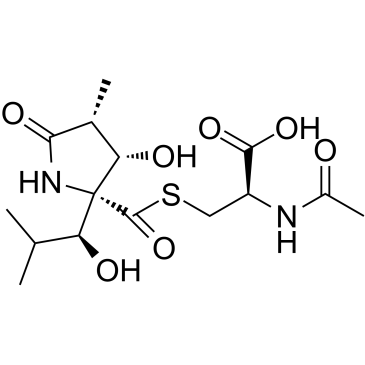
133343-34-7 structure
- Name: Lactacystin
- Chemical Name: lactacystin
- CAS Number: 133343-34-7
- Molecular Formula: C15H24N2O7S
- Molecular Weight: 376.425
- Catalog: Biochemical Protein research
- Create Date: 2018-06-26 18:13:05
- Modify Date: 2026-07-03 18:36:20
-
Lactacystin, an antibiotic Streptomyces spp. metabolite, is a potent and selective proteasome inhibitor with an IC50 of 4.8 μM for 20S proteasome. Lactacystin also inhibits the lysosomal enzyme cathepsin A[1]. Lactacystin inhibits cell growth and induces neurite outgrowth[2].
| Name | lactacystin |
|---|---|
| Synonyms |
Aids-008388
S-[2R,3S,4R]-3-HYDROXY-2-[(1S)-1-HYDROXY-2-METHYLPROPYL]-4-METHYL-5-OXO-2-PYROLIDINECBONYL LACTACYSTIN (NATIVE) (2R)-2-(Acetylamino)-3-[[(2R)-3β-hydroxy-4β-methyl-2-[(S)-1-hydroxy-2-methylpropyl]-5-oxopyrrolidine-2-yl]cbonylthio]propanoic acid N-ACETYL-S-[(2R,3S,4R)-3-HYDROXY-2-[(1S)-1-HYDROXY-2-METHYLPROPYL]-4-METHYL-5-OXO-2-PYRROLIDINECBONYL]-L-CYSTEINE Lacta LACTACYSTIN, SYNTHETIC Lactacystin, proteasome inhibitor N-Acetyl-S-[(3S,4R)-3-hydroxy-2-[(1S)-1-hydroxy-2-Methylpropyl]-4-Methyl-5-oxo-D-prolyl]-L-cysteine (2R,3S,4R)-3-HYDROXY-2-[(1S)-1-HYDROXY-2-METHYLPROPYL]-4-METHYL-5-OXO-2-PYRROLIDINECBOXY-N-ACETYL-L-CYSTEINE THIOESTER N-Acetyl-S-({(2R,3S,4R)-3-hydroxy-2-[(1S)-1-hydroxy-2-methylpropyl]-4-methyl-5-oxo-2-pyrrolidinyl}carbonyl)-L-cysteine L-Cysteine, N-acetyl-, (2R,3S,4R)-3-hydroxy-2-(1-hydroxy-2-methylpropyl)-4-methyl-5-oxo-2-pyrrolidinecboxylate (ester) (2R)-2-(Acetylamino)-3-[[[(2R,3S,4R)-2-[(1S)-2-methyl-1-hydroxypropyl]-3-hydroxy-4-methyl-5-oxopyrrolidin-2-yl]carbonyl]thio]propionic acid LACTACYSTIN //BP L-Cysteine, N-acetyl-S-[(3S,4R)-3-hydroxy-2-[(1S)-1-hydroxy-2-methylpropyl]-4-methyl-5-oxo-D-prolyl] Aids008388 3S-HYDROXY-2R-(1-HYDROXY-2-METHYLPROPYL)-4R-METHYL-5-OXO-2-PYRROLIDINECBOXYLATE-N-ACETYL-L-CYSTEINE (+)-Lactacystin MFCD01076525 N-Acetyl-S-({(2R,3S,4R)-3-hydroxy-2-[(1S)-1-hydroxy-2-methylpropyl]-4-methyl-5-oxopyrrolidin-2-yl}carbonyl)-L-cysteine LACTACYSTIN, STRTOMYCES SP LACTACYSTIN N-Acetyl-S-({(3S,4R)-3-hydroxy-2-[(1S)-1-hydroxy-2-methylpropyl]-4-methyl-5-oxo-2-pyrrolidinyl}carbonyl)-L-cysteine (+)-LACTACYSTIN |
| Description | Lactacystin, an antibiotic Streptomyces spp. metabolite, is a potent and selective proteasome inhibitor with an IC50 of 4.8 μM for 20S proteasome. Lactacystin also inhibits the lysosomal enzyme cathepsin A[1]. Lactacystin inhibits cell growth and induces neurite outgrowth[2]. |
|---|---|
| Related Catalog | |
| Target |
IC50: 4.8 μM (proteasome)[1] |
| In Vivo | Lactacystin (microinjection; 2 µg) induces a Parkinson’s disease-like motor phenotype 5-7 days after injection in young and adult mice[2]. Animal Model: Male C57Bl/6RccHsd mice with 8-9 weeks (young) and 12-14 months (adult) old[2] Dosage: 2 µg Administration: Microinjection Result: Induced a Parkinson’s disease-like motor phenotype 5-7 days after injection in young and adult mice. |
| References |
| Density | 1.4±0.1 g/cm3 |
|---|---|
| Boiling Point | 714.9±60.0 °C at 760 mmHg |
| Melting Point | 233-235ºC dec. |
| Molecular Formula | C15H24N2O7S |
| Molecular Weight | 376.425 |
| Flash Point | 386.1±32.9 °C |
| Exact Mass | 376.130432 |
| PSA | 178.33000 |
| LogP | -1.10 |
| Vapour Pressure | 0.0±5.2 mmHg at 25°C |
| Index of Refraction | 1.560 |
| Storage condition | −20°C |
| Personal Protective Equipment | Eyeshields;Gloves;type N95 (US);type P1 (EN143) respirator filter |
|---|---|
| RIDADR | NONH for all modes of transport |
| WGK Germany | 3 |