1440796-75-7
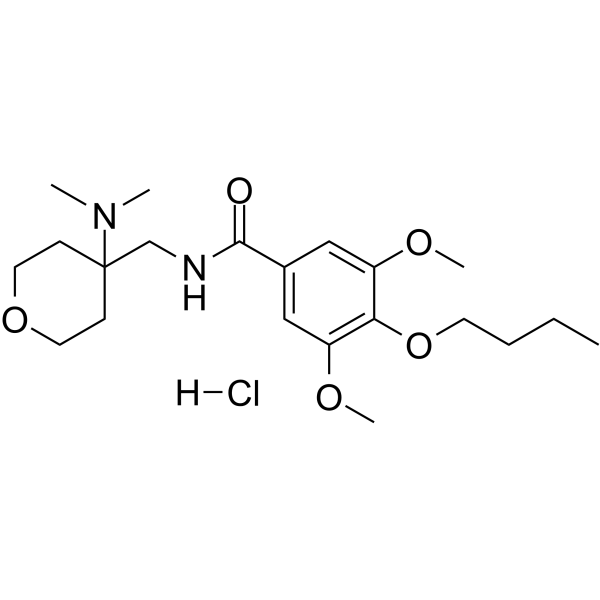
1440796-75-7 structure
- Name: Opiranserin hydrochloride
- Chemical Name: Opiranserin hydrochloride
- CAS Number: 1440796-75-7
- Molecular Formula: C21H35ClN2O5
- Molecular Weight: 430.97
- Catalog: Signaling Pathways GPCR/G Protein 5-HT Receptor
- Create Date: 2022-07-11 11:43:23
- Modify Date: 2026-08-08 08:42:40
-
Opiranserin (VVZ-149) hydrochloride, a non-opioid and non-NSAID analgesic candidate, is a dual antagonist of glycine transporter type 2 (GlyT2) and serotonin receptor 2A (5HT2A), with IC50s of 0.86 and 1.3 μM, respectively. Opiranserin hydrochloride shows antagonistic activity on rP2X3 (IC50=0.87 μM). Opiranserin hydrochloride is development as an injectable agent for the treatment of postoperative pain[1][2][3].
| Name | Opiranserin hydrochloride |
|---|---|
| Synonyms |
4-butoxy-N-[[4-(dimethylamino)oxan-4-yl]methyl]-3,5-dimethoxybenzamide
VVZ 149,analgesic,postoperative,VVZ-149,5-hydroxytryptamine Rector,5-HT Rector,anti-inflammatory,Opiranserin hydrochloride,Serotonin Rector,Inhibitor,pain,GlyT,Opiranserin,non-opioid,inhibit,P2X Rector,P2XRs,VVZ149,Glycine transporters Benzamide, 4-butoxy-N-[[4-(dimethylamino)tetrahydro-2H-pyran-4-yl]methyl]-3,5-dimethoxy-, hydrochloride (1:1) hydrochloride 4-butoxy-N-[[4-(dimethylamino)oxan-4-yl]methyl]-3,5-dimethoxybenzamide Opiranserin hydrochloride, 10 mM in DMSO |
| Description | Opiranserin (VVZ-149) hydrochloride, a non-opioid and non-NSAID analgesic candidate, is a dual antagonist of glycine transporter type 2 (GlyT2) and serotonin receptor 2A (5HT2A), with IC50s of 0.86 and 1.3 μM, respectively. Opiranserin hydrochloride shows antagonistic activity on rP2X3 (IC50=0.87 μM). Opiranserin hydrochloride is development as an injectable agent for the treatment of postoperative pain[1][2][3]. |
|---|---|
| Related Catalog | |
| Target |
GlyT2:0.86 μM (IC50) 5-HT2A Receptor:1.3 μM (IC50) rP2X3:0.87 μM (IC50) |
| References |
| Molecular Formula | C21H35ClN2O5 |
|---|---|
| Molecular Weight | 430.97 |