59-01-8
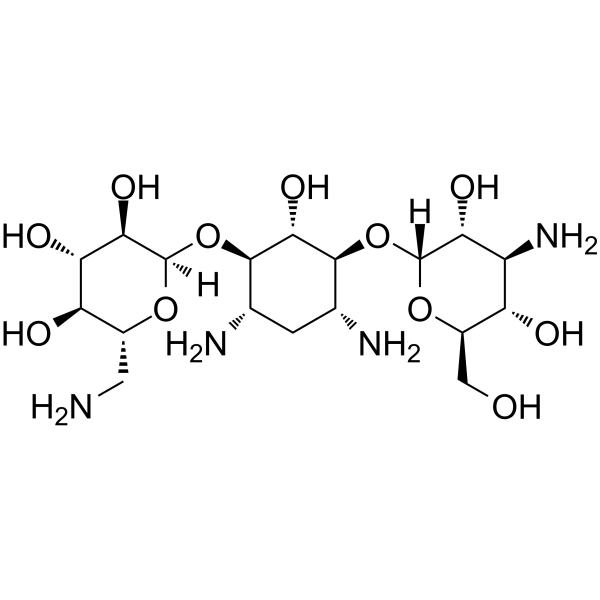
59-01-8 structure
- Name: kanamycin
- Chemical Name: kanamycin A
- CAS Number: 59-01-8
- Molecular Formula: C18H36N4O11
- Molecular Weight: 484.499
- Catalog: Pharmaceutical intermediate Heterocyclic compound Pyridine compound Ethylpyridine
- Create Date: 2018-07-10 18:11:40
- Modify Date: 2026-07-04 08:01:49
-
Kanamycin (Kanamycin A) is an orally active antibacterial (gram-negative/positive bacteria) agent, inhibits translocation and causes misencoding by binding to the 70 S ribosomal subunit. Kanamycin shows good inhibitory activity to both M. tuberculosis (sensitive and drug-resistant ) and K. pneumonia, which can be used in studies of tuberculosis and pneumonia[1][2][3][4].
| Name | kanamycin A |
|---|---|
| Synonyms |
KANAMYCIN //BP
Amikacin Impurity 4(Amikacin Impurity D) glucopyranoside,4,6-diamino-2-hydroxy-1,3-cyclohexylene3,6’diamino-3,6’-dideo kanamycin from Streptomyces kanamyceticus d-deoxydi Kanamycins Amikacin Impurity 4 1-O-[(1R)-2α-Hydroxy-3β-(3-amino-3-deoxy-α-D-glucopyranosyloxy)-4α,6α-diaminocyclohexane-1β-yl]-6-amino-6-deoxy-α-D-glucopyranose y-alpha-d-glucopyranosyl-)-2-deoxy 6-O-(3-Amino-3-deoxy-α-D-glucopyranosyl)-4-O-(6-amino-6-deoxy-α-D-glucopyranosyl)-2-deoxy-D-strtamine (2R,3S,4S,5R,6R)-2-(aminomethyl)-6-[(1R,2R,3S,4R,6S)-4,6-bis(azanyl)-3-[(2S,3R,4S,5S,6R)-4-azanyl-3,5-dihydroxy-6-(hydroxymethyl)oxan-2-yl]oxy-2-hydroxy-cyclohexyl]oxy-oxane-3,4,5-triol 4,6-Diamino-3-[(6-amino-6-deoxyhexopyranosyl)oxy]-2-hydroxycyclohexyl 3-amino-3-deoxyhexopyranoside d-strtamine,o-3-amino-3-deoxy-alpha-d-glucopyranosyl-(1.fwdw.6)-o-[6-amin d-xydi Amikacin Impurity D o-6-deoxy-alpha-d-glucopyranosyl-(1.fwdw.)]-2-deoxy (2R,3S,4S,5R)-2-(aminomethyl)-6-[(1R,2R,3S,4R,6S)-4,6-diamino-3-[(2S,3R,4S,5S,6R)-4-amino-3,5-dihydroxy-6-(hydroxymethyl)oxan-2-yl]oxy-2-hydroxycyclohexyl]oxyoxane-3,4,5-triol km(theantibiotic) KANAMYCIN BASE Kanamycin A in water gentamicin A Kanamycin free base KANAMYCIN 4-O-(6-Amino-6-deoxy-α-D-glucopyranosyl)-6-O-(3-amino-3-deoxy-α-D-glucopyranosyl)-2-deoxy-D-strtamine (2R,3S,4S,5R,6R)-2-(aminomethyl)-6-[(1R,2R,3S,4R,6S)-4,6-diamino-3-[(2S,3R,4S,5S,6R)-4-amino-3,5-dihydroxy-6-(hydroxymethyl)oxan-2-yl]oxy-2-hydroxycyclohexyl]oxyoxane-3,4,5-triol KANAMYCIN BASE ENTERPRISE STANDD Kannamycin Monosulfate KANAMYCIN A kanamicina KanamycinMonosulfateA 4,6-diamino-2-hydroxy-1,3-cyclohexane3,6’diamino-3,6’-dideoxydi-alpha-d-gluc 4,6-diamino-2-hydroxy-1,3-cyclohexane3,6’diamino-3,6’-dideoxydi-alpha-d-glucos d.6-O-(3-amino-3-deoxy-α-d-glucopyranosyl)-4-O-(6-amino-6-deoxy-α-d-glucopyranosyl)-2-deoxy-d-strtamine(kanamycin) D-Strtamine, O-3-amino-3-deoxy-α-D-glucopyranosyl-(1→6)-O-[6-amino-6-deoxy-α-D-glucopyranosyl-(1→4)]-2-deoxy Kanamycine 4))-2-deoxy-y-alpha-d-glucopyranosyl-( (2R,3S,4S,5R,6R)-2-(aminomethyl)-6-[(1R,2R,3S,4R,6S)-4,6-diamino-3-[(2S,3R,4S,5S,6R)-4-amino-3,5-dihydroxy-6-methylol-tetrahydropyran-2-yl]oxy-2-hydroxy-cyclohexoxy]tetrahydropyran-3,4,5-triol glucopyranoside,4,6-diamino-2-hydroxy-1,3-cyclohexylene3,6’-diamino-3,6’-di |
| Description | Kanamycin (Kanamycin A) is an orally active antibacterial (gram-negative/positive bacteria) agent, inhibits translocation and causes misencoding by binding to the 70 S ribosomal subunit. Kanamycin shows good inhibitory activity to both M. tuberculosis (sensitive and drug-resistant ) and K. pneumonia, which can be used in studies of tuberculosis and pneumonia[1][2][3][4]. |
|---|---|
| Related Catalog | |
| In Vitro | Kanamycin (0.1-100 μg/mL; 2 weeks) exhibits good antibacterial activity (MIC=1-5 μg/mL) to various strains of mycobacteria in vitro[1]. Cell Viability Assay[1] Cell Line: mycobacteria H37Rv, H2, H37RvR-PAS, Ravenel, Kirchbergand and BCG. Concentration: 0.1-100 μg/mL Incubation Time: 2 weeks Result: Showed good antibacterial activity to various strains of mycobacteria (H37Rv, H2, H37RvR-PAS, Ravenel, and BCG) with MICs were 1 μg/mL and 5 μg/mL for strain of Kirchbergand. |
| In Vivo | Kanamycin (2, 4 mg/kg; s.c.; once daily, 6 times a week for 3 weeks) inhibits growth of bovine tubercle bacilli in lung and spleen of mice[1]. Kanamycin (1.25, 5 mg/kg; s.c.; single (at 3 h after infection)) inhibits the multiplication of K. pneumonia DT-S in lung, trachea, and blood of mice and in proportion to the dose administration, and also increases the survival rate of mice[2]. Animal Model: Inbred strain normal mice (14-16 g; bovine tubercle bacilli (Ravenel strain) infected model)[1]. Dosage: 2, 4 mg/kg Administration: Subcutaneous injection; once daily, 6 times a week for 3 weeks. Result: Exerted a marked effect to inhibit the multiplication of the tuberculosis in vivo, especially in the lung of mice. Animal Model: Slc:ICR male mice (4-week-old; 18-24 g; K. pneumonia DT-S infection model (by the aerosol method))[2]. Dosage: 1.25, 5 mg/kg Administration: Subcutaneous administration; single (at 3 h after infection). Result: Suppressed the growth of K. pneumonia DT-S in lung, trachea, and blood in proportion to the dose administration. Resulted in 90% survival at 6 days after infection (negative control group: all died within 4 days), and cleared the K. pneumonia DT-S from lung, trachea, and blood of mice within 48 h (when dosage at 5 mg/kg). |
| References |
| Density | 1.6±0.1 g/cm3 |
|---|---|
| Boiling Point | 809.5±65.0 °C at 760 mmHg |
| Molecular Formula | C18H36N4O11 |
| Molecular Weight | 484.499 |
| Flash Point | 443.4±34.3 °C |
| Exact Mass | 484.238068 |
| PSA | 282.61000 |
| LogP | -2.58 |
| Vapour Pressure | 0.0±6.5 mmHg at 25°C |
| Index of Refraction | 1.670 |
CHEMICAL IDENTIFICATION
HEALTH HAZARD DATAACUTE TOXICITY DATA
MUTATION DATA
|
| WGK Germany | 2 |
|---|