34233-69-7
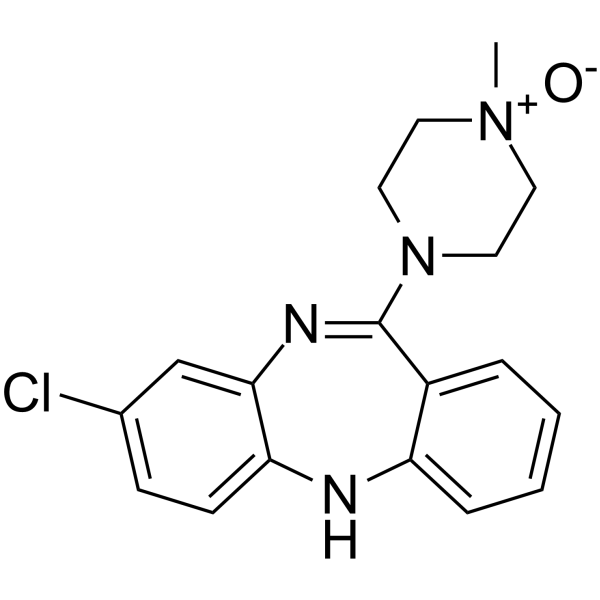
34233-69-7 structure
- Name: Clozapine N-oxide
- Chemical Name: clozapine n-oxide
- CAS Number: 34233-69-7
- Molecular Formula: C18H19ClN4O
- Molecular Weight: 342.823
- Catalog: Signaling Pathways GPCR/G Protein 5-HT Receptor
- Create Date: 2018-10-14 18:21:41
- Modify Date: 2026-06-30 10:53:05
-
Clozapine N-oxide (CNO) is a major metabolite of the anti-psychotic drug clozapine. Clozapine N-oxide is a agonist for the chemogenetic Designer Receptors Exclusively Activated by Designer Drug (DREADD) system.
| Name | clozapine n-oxide |
|---|---|
| Synonyms |
8-Chloro-11-(4-methyl-4-oxido-1-piperazinyl)-5H-dibenzo[b,e][1,4]diazepine
CNO (Clozapine N-oxide) 4-(8-Chloro-5H-dibenzo[b,e][1,4]diazin-11-yl)-1-methylpiperazine 1-oxide Clozapine N-oxide (4-oxido-piprazinyl) MAJORMETABOLITEOFCLOZAPINE.POSSESSESLITTLEORNOACTIVITYAT5-HTRECTORS Clozapine N-oxide solution 3-Chloro-6-(4-methyl-4-oxidopiperazin-4-ium-1-yl)-5H-benzo[b][1,4]benzodiazine 8-Chloro-11-(4-methyl-4-oxido-1-piperazinyl)-5H-dibenzo[b,e][1,4]diazine 5H-Dibenzo[b,e][1,4]diazine, 8-chloro-11-(4-methyl-4-oxido-1-piperazinyl) Clozapine N-Oxide (1.0 mg/mL in Methanol) Clozapine N-oxide, Metabolite of Clozapine Clozapine (N-oxide) CLOZAPINE N-OXIDE, 10 mM in DMSO 8-Chloro-11-(4-methyl-1-piperazinyl)-5H-dibenzo[b,e](1,4)diazepine N-oxide Clozapine N-Oxide imp CLOZAPINE N-OXIDE Clozapine Impurity 16 e)(1,4)diazine,8-chloro-11-(4-methyl-1-piperazinyl)-5h-dibenzo(n-oxide Clozapine impurity 5/Clozapine N-Oxide/4-(8-chloro-5H-dibenzo[b,e][1,4]diazin-11-yl)-1-methylpiperazine 1-oxide Clozapine N-oxide (CNO) Clozapine N-oxide (4-oxido-piprazinyl) in methanol 8-CHLORO-11-[4-METHYL-1-PIPERAZINYL]-5H-DIBENZO[B,E][1,4]DIAZINE N-OXIDE Clozapine N-oxide Methanol Adduct Clozapine N-oxide dihydrochloride NEW Clozapine N-oxide, Metabolite of Clozapine (aqueous solution) Clozapine N-OxideQ: What is Clozapine N-Oxide Q: What is the CAS Number of Clozapine N-Oxide Q: What is the storage condition of Clozapine N-Oxide Q: What e the applications of Clozapine N-Oxide |
| Description | Clozapine N-oxide (CNO) is a major metabolite of the anti-psychotic drug clozapine. Clozapine N-oxide is a agonist for the chemogenetic Designer Receptors Exclusively Activated by Designer Drug (DREADD) system. |
|---|---|
| Related Catalog | |
| Target |
DREADD[1] |
| In Vivo | After a single intraperitoneal (i.p.) injection of Clozapine N-oxide (1 mg/kg) into mice, Clozapine N-oxide (CNO) plasma levels peak at 15 min and are very low after 2 h. Acutely administered CNO can be metabolically converted to Clozapine in other species such as human and guinea-pig. The metabolites that may form after chronic administration of CNO to DREADD-expressing mice (or other species) have not been studied systematically. However, even if back-transformation to Clozapine occurs after chronic CNO administration, it should be noted that Clozapine is a more potent (by ~10-fold) DREADD agonist than CNO itself. Moreover, confounding biological effects of potential CNO metabolites can be easily identified by including both saline- and CNO-treated WT animals in a particular DREADD study. Despite the short plasma half-life of CNO in mice, the biological effects that have been described after acute treatment of DREADD-expressing experimental animals are usually much longer (6-10 h). One possibility is that CNO tends to accumulate in tissues, although other scenarios are also feasible[1]. Using a general pharmacokinetic model for the interconversion process, the mean total clearances of Clozapine and Clozapine N-oxide (CNO) are 28.45 L/hr and 45.30 L/hr, respectively[2]. |
| References |
| Density | 1.36g/cm3 |
|---|---|
| Boiling Point | 517.4ºC at 760mmHg |
| Melting Point | 190-248ºC |
| Molecular Formula | C18H19ClN4O |
| Molecular Weight | 342.823 |
| Flash Point | 266.7ºC |
| Exact Mass | 342.124725 |
| PSA | 57.06000 |
| LogP | 0.76 |
| Index of Refraction | 1.685 |
| Storage condition | 2-8℃ |
CHEMICAL IDENTIFICATION
HEALTH HAZARD DATAACUTE TOXICITY DATA
|
| Symbol |

GHS06 |
|---|---|
| Signal Word | Danger |
| Hazard Statements | H301-H315-H319-H335 |
| Precautionary Statements | P261-P301 + P310-P305 + P351 + P338 |
| Personal Protective Equipment | dust mask type N95 (US);Eyeshields;Faceshields;Gloves |
| Hazard Codes | Xn: Harmful; |
| Risk Phrases | 22-36/37/38 |
| Safety Phrases | 26-36 |
| RIDADR | UN 2811 6.1/PG 3 |
| RTECS | HP1760000 |
| Packaging Group | III |
| Hazard Class | 6.1(b) |