19186-33-5
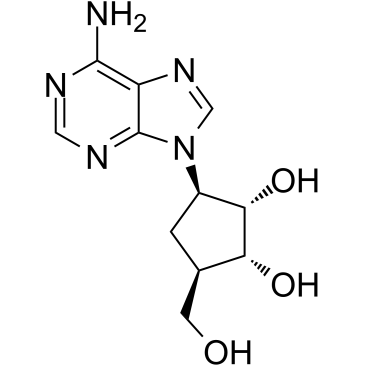
19186-33-5 structure
- Name: Aristeromycin
- Chemical Name: Aristeromycin
- CAS Number: 19186-33-5
- Molecular Formula: C11H15N5O3
- Molecular Weight: 265.26900
- Catalog: Research Areas Cancer
- Create Date: 2018-05-03 08:00:00
- Modify Date: 2026-07-04 08:52:41
-
Aristeromycin, an adenosine analog, is an antibiotic and a potent S-adenosylhomocysteine hydrolase (AHCY) inhibitor[1][2].
| Name | Aristeromycin |
|---|---|
| Synonyms |
1,2-cyclopentanediol,3-(6-amino-9h-purin-9-yl)-5-(hydroxymethyl)-,(1r,2s,3r,5
Cycloadenosine (1r,2s,3r,5r)-3-(6-amino-9h-purin-9-yl)-5-(hydroxymethyl)-1,2-cyclopentanedi Cbocyclic adenosine ISTEROMYCIN 9-[2,3-DIHYDROXY-4-(HYDROXYMETHYL)CYCLOPENTYL]ADENINE 4'-O-Cbaadenosine 4'-O-Carbaadenosine 3-isteromycin 1,2-Cyclopentanediol, 5-(6-amino-9H-purin-9-yl)-3-(hydroxymethyl)-, (1S,2R,3R,5R) (-)-isteromycin (1R,2S,3R,5R)-3-(6-Amino-9H-purin-9-yl)-5-(hydroxymethyl)-1,2-cyclopentanediol carbocyclic adenosine (1R,2S,3R,5R)-3-(6-amino-9H-purin-9-yl)-5-(hydroxymethyl)cyclopentane-1,2-diol |
| Description | Aristeromycin, an adenosine analog, is an antibiotic and a potent S-adenosylhomocysteine hydrolase (AHCY) inhibitor[1][2]. |
|---|---|
| Related Catalog | |
| Target |
S-adenosylhomocysteine hydrolase[1] |
| In Vitro | The IC50 value of Aristeromycin against AHCY is 38.5 nM at 50 μM SAH (approximately equal to the Km: 48 μM), but 271 nM at 1000 µM SAH (20× Km). With 60 min of preincubation, the mean IC50 value of Aristeromycin at 50 μM SAH is 12.7 nM[1]. Aristeromycin has IC50 values of 3.2 μM for LNCaP-FGC cell growth and 0.88 μM for LNCaP-hr cell growth[1]. At least in part, Aristeromycin can regulate oncogenic EZH2 expression by inducing miR-26a[1]. |
| References |
| Density | 1.92g/cm3 |
|---|---|
| Boiling Point | 595.1ºC at 760mmHg |
| Molecular Formula | C11H15N5O3 |
| Molecular Weight | 265.26900 |
| Flash Point | 313.7ºC |
| Exact Mass | 265.11700 |
| PSA | 130.31000 |
| Vapour Pressure | 5.19E-15mmHg at 25°C |
| Index of Refraction | 1.881 |
| Storage condition | -20°C |
| WGK Germany | 3 |
|---|---|
| RTECS | GY4250000 |
| Precursor 4 | |
|---|---|
| DownStream 1 | |


