55-03-8
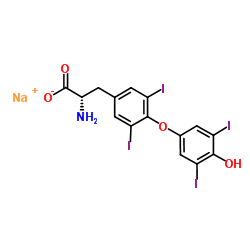
55-03-8 structure
- Name: L-Thyroxine sodium
- Chemical Name: levothyroxine sodium anhydrous
- CAS Number: 55-03-8
- Molecular Formula: C15H20I4NNaO9
- Molecular Weight: 798.852
- Catalog: API Hormone and endocrine-regulating drugs Thyroid hormone and antithyroid drugs
- Create Date: 2018-06-27 09:19:44
- Modify Date: 2026-07-03 13:20:55
-
L-Thyroxine sodium (Levothyroxine sodium) is a synthetic hormone for the research of hypothyroidism. DIO enzymes convert biologically active thyroid hormone (Triiodothyronine,T3) from L-Thyroxine (T4)[1].
| Name | levothyroxine sodium anhydrous |
|---|---|
| Synonyms |
sodium (s)-2-amino-3-[4-(4-hydroxy-3,5-diiodophenoxy)-3,5-diiodophenyl]propionate
L-Thyroxine monosodium salt levothyroxine sodium anhydrousdium anhydrous (S)-2-Amino-3-[4-(4-hydroxy-3,5-diiodophenoxy)-3,5-diiodophenyl]propionic Acid odium 3-[4-(4-HYDROXY-3,5-DIIODOPHENOXY)-3,5-DIIODOPHENYL]-L-ALANINE SODIUM SALT PENTAHYDRATE Levothyroxine sodium RS L-Tyrosine, O-(4-hydroxy-3,5-diiodophenyl)-3,5-diiodo-, sodium salt (1:1) 3-[4-(4-HYDROXY-3,5-DIIODOPHENOXY)-3,5-DIIODOPHENYL]-L-ALANINE PENTAHYDRATE L-THYROXINE SODIUM PENTAHYDRATE Levothyroxine (L-Thyroxine) sodium L-Tyrosine, O- (4-hydroxy-3,5-diiodophenyl)-3,5-diiodo-, monosodium salt Sodium Levothyroxine 3-Amino-4-(4-(4-OH-3,5-diiodophenoxy)-3,5-diiodophenyl))but.ac.Na salt Levothyroxine sodium L-Tyrosine,O-(4-hydroxy-3,5-diiodophenyl)-3,5-diiodo-, sodiuM salt (1:1) sodiuM (S)-2-amino-3-(4-(4-hydroxy-3,5-diiodophenoxy)-3,5-diiodophenyl)propanoate (s)-2-amino-3-[4-(4-hydroxy-3,5-diiodophenoxy)-3,5-diiodophenyl]propionic acid sodium salt L-Thyroxine sodium, 10 mM in DMSO LT4 sodium|||Levothyroxine sodium|||L-T4 sodium L-3,3',5,5'-Tetraiodothyronine Sodium Salt Levaxin Levothyroxine Sodium / L-Thyroxinesodium/L-Thyroxine Sodium Pentahydrate Euthyrox Sodium 4-O-(4-hydroxy-3,5-diiodophenyl)-3,5-diiodo-L-tyrosine Thyroxine Soduim Salt Thyro-Tabs O-(4-Hydroxy-3,5-diiodophenyl)-3,5-diiodo-L-tyrosine Monosodium Salt Levothroid EINECS 200-221-4 (S)-2-Amino-3-[4-(4-hydroxy-3,5-diiodophenoxy)-3,5-diiodophenyl]propionic Acid Sodium Salt Sodium (S)-2-Amino-3-[4-(4-hydroxy-3,5-diiodophenoxy)-3,5-diiodophenyl]propionate Synthroid Sodium (2S)-2-amino-3-[4-(4-hydroxy-3,5-diiodophenoxy)-3,5-diiodophenyl]propanoate Oroxine (S)-2-Amino-3-[4-(4-hydroxy-3,5-diiodophenoxy)-3,5-diiodophenyl]propionic Acid Sodium Salt Pentahydrate Levothyroxine sodium ,T4 L-THYROXINE SODIUM SALT PENTAHYDRATE Levoxyl Sodium l-thyroxin LT4 sodium L-THYROXINE SODIUM ANHYDROUS Eltroxin Levothyroxine Sdium L-Tyrosine, O-(4-hydroxy-3,5-diiodophenyl)-3,5-diiodo-, monosodiumsalt L-ThyroxineSodiumSaltB.P SODIUM (S)-2-AMINO-3-[4-(4-HYDROXY-3,5-DIIODOPHENOXY)-3,5-DIIODOPHENYL]PROPIONATE PENTAHYDRATE Levothyroxine SodiumQ: What is Levothyroxine Sodium Q: What is the CAS Number of Levothyroxine Sodium Q: What is the storage condition of Levothyroxine Sodium Q: What e the applications of Levothyroxine Sodium L-T4 sodium SODIUM L-THYROXINE L-Thyroxine sodium salt Levothyroxine sodium //BP |
| Description | L-Thyroxine sodium (Levothyroxine sodium) is a synthetic hormone for the research of hypothyroidism. DIO enzymes convert biologically active thyroid hormone (Triiodothyronine,T3) from L-Thyroxine (T4)[1]. |
|---|---|
| Related Catalog | |
| In Vivo | Deiodinases (DIOs), which catalyse the conversion of thyroxine (pro-hormone) to the active thyroid hormone, are associated with thyroid stimulating hormone (TSH) levels. DIO1 and DIO2 catalyze activation of thyroid hormone secretion in contrast to DIO3 playing role inactivation of the secretion. Activities of DIO1 and DIO2 play pivotal role in the negative feedback regulation of pituitary TSH secretion[1]. L-Thyroxine (T4) and Triiodothyronine (T3) hormones are known to modulate the expression of ionic channels, pumps and regulatory contractile proteins. Moreover, thyroid hormones have been shown to influence calcium homeostasis and flux responsible for excitation and contractility, with L-Thyroxine and Triiodothyronine modulating its pharmacological control and secretion. In rats fed 12 weeks with the iodine-free diet, a significant decrease in the levels of both Triiodothyronine and L-Thyroxine is observed when compared to the control group fed with standard diet (p<0.001). In the group treated with low doses of L-Thyroxine, an increase in L-Thyroxine levels is observed (p=0.02) while Triiodothyronine levels remain virtually similar to the control group (p=0.19). Rats treated with high doses of L-Thyroxine display a significant increase in both Triiodothyronine and L-Thyroxine circulating concentrations compared to the non-treated hypothyroid group (p<0.001 and p=0.004, respectively) and a significant increase in L-Thyroxine levels when compared to the control values (p=0.03)[2]. |
| References |
| Boiling Point | 576.3ºC at 760 mmHg |
|---|---|
| Melting Point | 207-210 (dec.)(lit.)ºC |
| Molecular Formula | C15H20I4NNaO9 |
| Molecular Weight | 798.852 |
| Flash Point | 302.3ºC |
| Exact Mass | 798.668579 |
| PSA | 141.76000 |
| LogP | 3.60140 |
CHEMICAL IDENTIFICATION
HEALTH HAZARD DATAACUTE TOXICITY DATA
|
| Safety Phrases | S22-S24/25 |
|---|---|
| RIDADR | UN 2811 |
| WGK Germany | 3 |
| RTECS | YP2833760 |
| Packaging Group | II |
| Hazard Class | 6.1(a) |
|
~99%
55-03-8 |
| Literature: CADILA PHARMACEUTICALS LTD. Patent: WO2009/136249 A1, 2009 ; Location in patent: Page/Page column 5 ; |
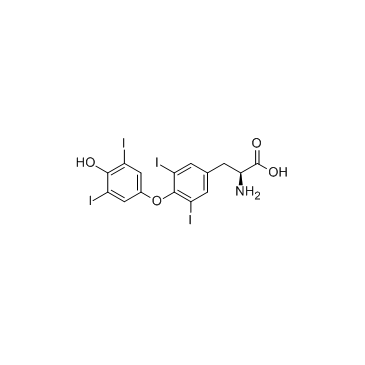
| Precursor 1 | |
|---|---|
| DownStream 0 | |